Millions of finished vehicles roll out of production halls every year. The pace of work is dizzying, and the pressure is enormous. In the automotive industry the margin for error simply does not exist — the slightest deviation from the standard, even by a fraction of a millimeter, can trigger an avalanche of consequences. We are talking about massive financial losses, production stoppages, and even a long-term blow to reputation. That is precisely why robotization of processes in the automotive industry ceased to be a futuristic vision and became an absolute necessity. Without advanced systems that, step by step, are revolutionizing the traditional production line, modern plants would not be able to maintain such a demanding pace, let alone meet the rigorous quality standards.
The robotization of processes also solves the problem of costly, time-consuming, and complicated mechanical retooling when the market requires a change in the product assortment. Single-function devices are being replaced by multi-axis intelligent industrial robots. As a result, robotics today plays a key role in the flexible management of the product life cycle. The same robotic arms can assemble a city hatchback and, after a new program is uploaded, a luxury SUV on the same line. For managers, this means a drastic shortening of time-to-market and optimization of depreciation costs across the entire machinery fleet.
How are robots used in the automotive industry? Key areas of deployment
The automotive industry is an absolute pioneer when it comes to deploying robotic arms on a large scale. Today’s factories are precisely designed ecosystems divided into specialized technological zones. Robots are present at every key stage of a vehicle’s manufacture. They have taken from humans the most monotonous and dangerous tasks, as well as those that require surgical precision, operating at a speed unattainable for human hands. Below we list the main processes whose robotization in the automotive industry brings the greatest benefits. In a separate post you will also learn, Which industrial robots are most commonly used in the automotive industry.
Welding, spot welding and gluing of the bodywork
The welding shop is the kingdom of six-axis articulated robots. They constitute the absolute foundation of this department, responsible for precise spot welding and modern laser welding. Efficient welding robots programming is the key to the success of the entire process. Why is it so important? The extreme repeatability of machine movements guarantees that the body geometry will be perfect in every vehicle. It is on this precision that the crash safety of the car we buy at the dealership later depends. Robotic arms increasingly also apply modern structural adhesives and sealants. This not only provides high body stiffness, but also creates a durable anti-corrosion barrier. Learn more about robotic welding in the article Robotic welding: how to reduce production costs and speed up order fulfillment?.
Lacquering and surface protection
The paint shop is one of the most demanding environments in the entire factory. There are conditions of elevated risk of explosion, so the painting robots working there must comply with the strict ATEX safety standards. The machines use electrostatic paint application technology. Thanks to this, the coating has a perfect, identical thickness across every square centimeter, and material consumption and the amount of waste are reduced to a minimum. The robots also excel at applying sound-deadening compounds to the chassis. As a result, humans have been isolated from the nuisance and health-hazardous chemical fumes.
Final assembly and manipulation of heavy components
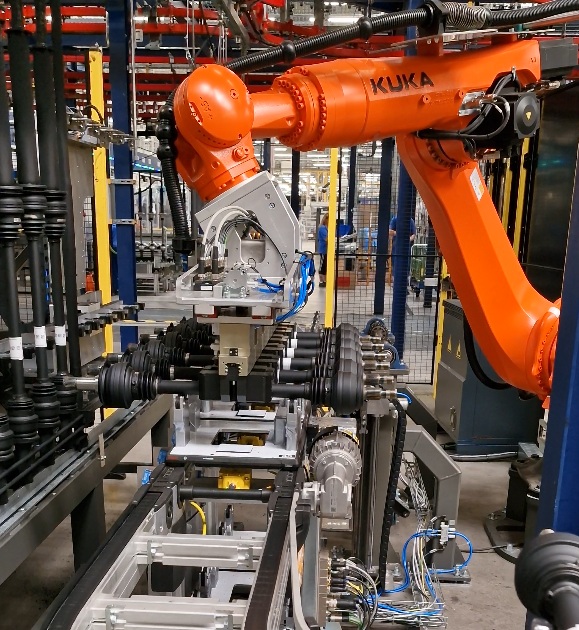
When the body is ready, the process enters the final assembly phase. Here heavy industrial robots with impressive lifting capacity step into action. They effortlessly manipulate components weighing several hundred kilograms each — transporting complete engines, exhaust systems, or entire cockpits.
An excellent example of technological advancement is the adhesive bonding of front and side windows. Robot arms work together here with 3D positioning systems. The machine automatically scans the edges of the bodywork, continuously corrects the movement path, and places the glass with an accuracy of tenths of a millimeter. For a human, at that pace of work, it would be an extremely difficult task.
Automated quality control and vision systems
In a modern factory there is no room for spot quality control. Every detail must be perfect. That is why, at the end of the production line, there are robots equipped with vision systems, high-resolution cameras and 3D laser scanners. These devices perform non-contact measurements of assembly gaps in the industry called flush & gap and meticulously analyze the paint coating in search of microscopic contaminants or runs. Such automation allows the complete elimination of errors caused by human visual fatigue.
Internal logistics and automatic transport of components
The heart of a modern factory beats to the rhythm of “exactly on time” (Just-In-Time) deliveries. To ensure assembly proceeds without disruption, logistics in the plant has been almost completely automated. Traditional forklifts are giving way to autonomous mobile robots AGV and AMR. These intelligent platforms independently circulate between the warehouse and the production line, delivering precisely selected components straight into the hands of assemblers. (You can learn more about mobile robots in our article: “AGV and AMR Mobile Robots in Industry – What Is the Difference Between an Autonomous Robot and a Guided Vehicle?“.) They are supported by robots of the type Pick-and-Place, which by means of advanced grippers automatically pick up parts from bulk containers and arrange them in the appropriate sequence. Such an organization of transport not only eliminates downtime, but also drastically increases safety in production halls.
Benefits of robotization of processes in car manufacturing
The implementation of industrial robotization is a decision based on hard economic data, ROI indicators and actual efficiency. Once the budget has been approved, concrete, long-term benefits for the company become of key importance. The implementation of robotic systems can be divided into two main areas: operational efficiency (financial benefits) and optimization of the work environment (changes within the production hall).
Maximization of efficiency and optimization of costs
In production management, one of the most important indicators is OEE (Overall Equipment Effectiveness). This parameter precisely reveals all downtimes and drops in efficiency, illustrating the degree of utilization of the plant’s real potential. Robotization directly influences the improvement of each of the three components of the OEE indicator:
- Higher machine availability: Robots operate continuously, without the need to schedule regeneration breaks, which eliminates the risk of absenteeism. Thanks to this, production volume planning is based on precise mathematical data rather than estimates. Furthermore, modern units, thanks to systems Predictive Maintenance systems, can independently signal the need for service before a failure occurs.
- Increased efficiency and repeatability: Machines guarantee a stable, identical work pace around the clock. This is clearly visible in the automotive industry, where the robotization of processes is the standard. Precise welding or applying layers of adhesive during windshield installation require consistent accuracy that a human — due to natural fatigue after many hours of work — is unable to maintain to the same extent.
- Higher quality and loss reduction: Eliminating the human factor of error resulting from routine drastically reduces the number of defective products. Limiting batches that are non-compliant with standards translates into real savings: reductions in the costs of waste, raw materials, and rework that previously burdened the project budget.
Improvement of security and reorganization of personnel
The thesis that robotization leads solely to the irreversible elimination of jobs is an oversimplification, although it cannot be denied that automation is associated with the optimization of employment. In practice this process has a twofold character: on the one hand, machines relentlessly replace human hands in simple and repetitive tasks, which often forces staff reductions; on the other hand, they open up space for the transformation of remaining positions with regard to occupational health and safety and skills development. The key aspects of this process are:
- Protection of workers’ health: Activities such as carrying heavy parts, palletizing, or monotonous, forced body positions are the main causes of injuries and sickness-related absences. Transferring these tasks to robot arms and manipulators allows for significant physical relief for personnel.
- Elimination of environmental hazards: Many manufacturing processes involve difficult conditions – toxic fumes in paint shops, sparks at welding stations, dust or high noise levels. Automation of these areas allows operators to be kept away from direct danger, creating a safer workplace.
- Change in the structure and value of job positions: Automation naturally reduces the demand for simple physical labor, which in practice means a reduction of positions at the lowest operational levels. However, for the portion of the workforce that remains with the company, a path to retraining opens up. Workers relieved of routine tasks move toward supervising control systems, programming, or maintenance activities. As a result, although the overall number of production positions falls, those that remain gain in value — employees raise their competencies, and the enterprise builds a smaller but more highly qualified team.
What implementation challenges does the integration of robots with the existing machine park entail?
Of course, implementing a robot is not a walk in the park – engineers face many challenges. Introducing advanced robotic stations in production environments is a complex process that requires overcoming many technological and organizational barriers. The key challenges in this area include:
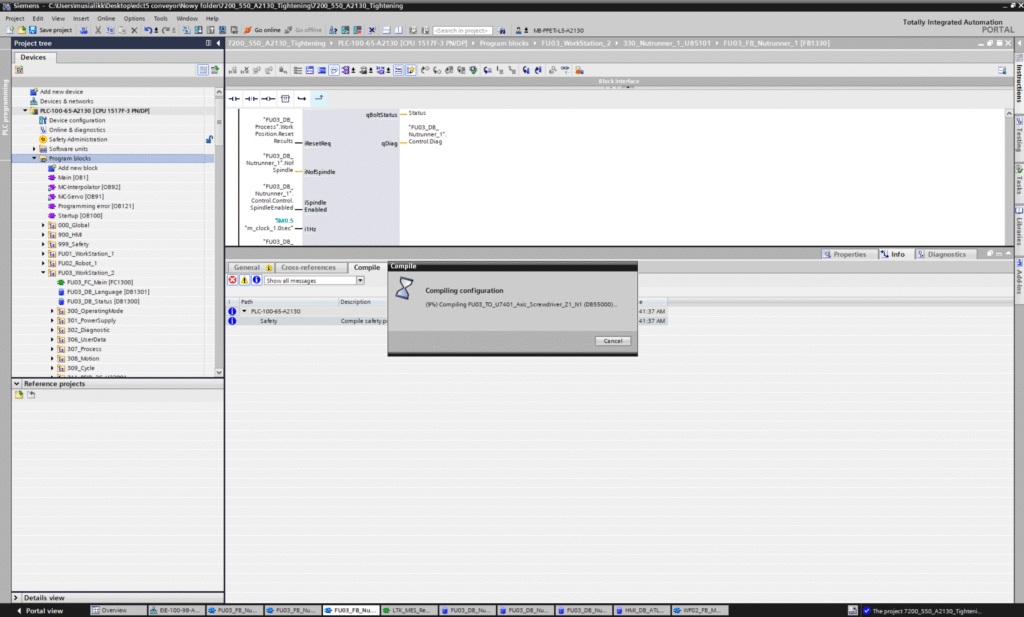
- Integration with the existing machine park – The biggest challenge is ensuring seamless real-time communication between new robots and older, often decades-old infrastructure. Connecting devices of different generations into a single cohesive entity requires the implementation of universal and stable data transmission standards, such as OPC UA or PROFINET. In this process, advanced control systems, PLC controllers and intuitive HMI panels offered by experienced automation suppliers are crucial.
- Cybersecurity of industrial networks – Modern technologies and opening up OT (Operational Technology) architecture for data exchange cause industrial networks to become targets of cyberattacks. Protecting the integrity of production systems is currently one of the deployment priorities.
- Risk of costly downtime – Every minute of unplanned production line downtime during the installation and testing of a new machine generates enormous financial losses. To minimize this risk, before physically placing the robot on the shop floor, the entire application is usually verified in a virtual environment using digital twin technology (Digital Twin).
- Advanced robot programming and software implementation – The physical anchoring of the machine is only the beginning of the process. For the robotic arms to carry out assigned tasks with surgical precision, their appropriate software is crucial. Contemporary robot programming requires unique competencies, and errors during the code creation phase can affect the performance of the entire line.
- Competence deficit and the human factor – Software alone is one thing, but the market today is facing a serious shortage of qualified engineers who can manage complex systems. An additional challenge is the necessity of retraining the current factory workforce to work in the new environment.
- Rigorous safety standards – The introduction of an autonomous, heavy robot into a space where people work requires designing advanced safety systems (e.g. laser scanners, light curtains, or barriers) that comply with applicable machinery directives.