Choosing a robot brand is a 10–15 year investment. This decision affects not only production efficiency but also your plant’s IT architecture, service availability, and energy costs. In today’s technological landscape, the market is divided into two main paths: traditional industrial powerhouses and flexible collaborative systems (cobots).
- The “Big Four” – the backbone of mass production
- Collaborative Robot Leaders – flexibility and safety
- Comparison table: industrial robot vs cobot
- Digital twins and offline simulation – the key to rapid ROI
- How to preliminarily select the right robot model for a task?
- Summary and Amister Recommendation
- FAQ – Frequently Asked Questions
The “Big Four” – the backbone of mass production
If your priority is 24/7 operation, maximum speed, long reach, and the ability to handle heavier payloads, you should consider one of the giants that have defined modern robotics.
1. FANUC (Japan)
The world’s largest manufacturer. FANUC robots are renowned for their high mean time between failures (MTBF).
- Advantages: Unified control across the smallest units up to giants with 2.3-ton payloads. Excellent integration with CNC machines.
- Key Series: R-2000iC (general-purpose), M-2000iA (heavy payloads).
2. ABB (Switzerland/Sweden)
ABB sets industry standards for software and cloud integration.
- Advantages: Market-leading simulation environment RobotStudio (Digital Twin). OmniCore controllers reduce energy consumption by 20%.
- Key Series: IRB 6700 (automotive), IRB 1100 (small components).
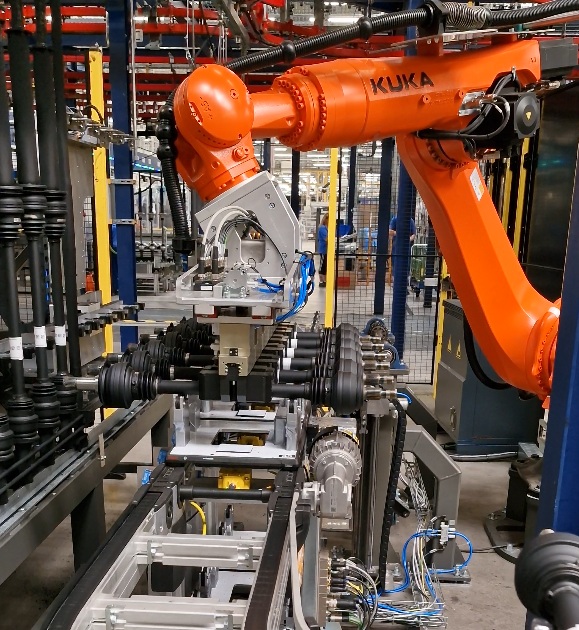
3. KUKA (Germany)
German engineering with strong backing from the Midea Group. A standard in European automotive manufacturing.
- Advantages: Windows-based operating system (IT-friendly), exceptional motion precision and structural rigidity.
- Key Series: KR QUANTEC (most popular), KR AGILUS (small and fast).
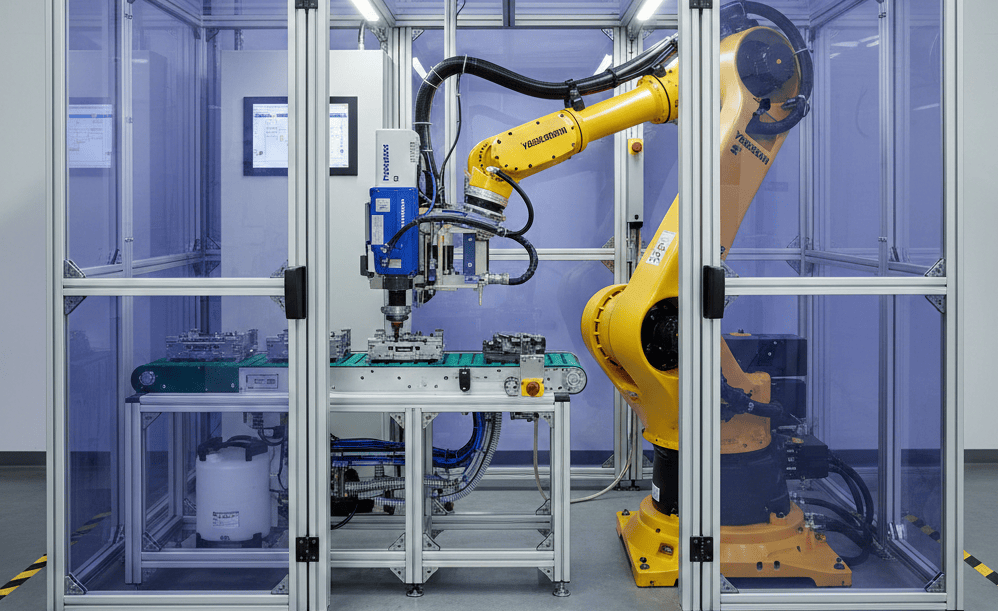
4. YASKAWA / MOTOMAN (Japan)
Pioneers in robotic welding. Their robots are known for smooth motion and advanced path algorithms.
- Advantages: Unique controllers capable of handling up to eight arms simultaneously. i³-Mechatronics philosophy integrates real-time process data.
- Key Series: GP (General Purpose), AR (Arc welding).
Collaborative Robot Leaders – flexibility and safety
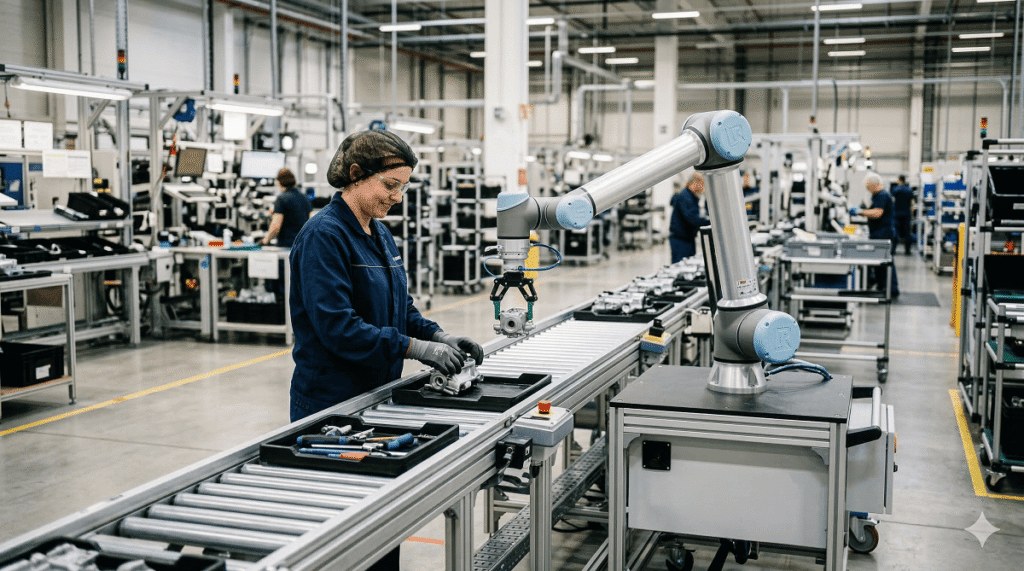
Collaborative robots (cobots) have transformed the market by enabling humans and robots to work side by side (without safety fences) and simplifying deployment.
1. Universal Robots (Denmark)
Creator of the first commercial cobot. UR offers the world’s largest accessory ecosystem (UR+).
- Why it matters: Plug-and-play. A robot can be unboxed and operational in just a few hours. The latest UR20 and UR30 models offer payloads and reach comparable to industrial robots while maintaining cobot safety and flexibility.
2. Doosan Robotics (South Korea)
A Korean heavyweight, emerging in 2026 as UR’s strongest competitor.
- Why it matters: Their H-series cobots feature torque sensors on all six joints, making them among the safest on the market. They also offer unique AI solutions, such as the P-series for palletizing.
3. FANUC CRX
FANUC’s answer to UR’s success. The CRX series combines cobot simplicity with the durability of traditional industrial robots.
- Why it matters: Offers an 8-year maintenance-free guarantee. Ideal for facilities seeking a cobot but trusting only Japanese mechanical reliability.
4. Techman Robot (Taiwan)
An innovative manufacturer, first to integrate a vision system directly into the robot arm.
- Why it matters: Perfect for pick-and-place and quality control tasks requiring shape recognition without purchasing expensive external vision systems.
Comparison table: industrial robot vs cobot
| Feature | Industrial Robot | Collaborative Robot (Cobot) |
| Speed | Very high (up to 10 m/s) | Limited for safety reasons |
| Safety | Requires safety fences / light curtains | Safe for human interaction |
| Programming | Text-based / Advanced | Graphical / Hand-guided |
| Mobility | Fixed / Stationary | Lightweight, easy to relocate |
| Applications | Mass production, heavy components | Assembly, packaging, worker assistance |
Digital twins and offline simulation – the key to rapid ROI
In modern robotics, hardware is only half the success. The true value lies in software. Contemporary programming environments allow the creation of a Digital Twin of a workstation, eliminating the risk of collisions and design errors.
Most popular engineering environments for industrial robots:
- ABB RobotStudio: Enables full 3D programming and optimization. Thanks to the virtual controller, code developed on a computer behaves identically on the physical machine.
- Fanuc ROBOGUIDE: Offers dedicated modules (e.g., HandlingPRO) that accurately calculate energy consumption and optimize motion paths for gearbox longevity.
- KUKA.Sim: Allows rapid creation of line layouts and export of simulations to Augmented Reality (AR), simplifying concept validation for management.
Using Virtual Commissioning can reduce line downtime during robot deployment by up to 50%.
How to preliminarily select the right robot model for a task?
Before making a decision, consider the following technical aspects:
- Payload: Always choose a model with a 15–20% safety margin to avoid pushing the gearbox to its limits.
- Reach: Remember to account for the gripper/tool dimensions when calculating reach. Payload capacity decreases as the robot extends further.
- Environment: Will the robot operate in high temperatures (foundry), high humidity (food industry), or clean areas (pharmaceuticals)? Manufacturers offer specialized versions (e.g., IP67, Foundry Pro).
- Human Collaboration: If payload allows, consider whether the robot is intended for continuous operation in a confined area or for collaborative tasks with humans.
Summary and Amister Recommendation
The choice depends on your production needs and strategy:
- If you are building a welding line for thousands of repetitive components – aim for Yaskawa or FANUC.
- If you need flexible support at an assembly station that handles different tasks weekly – choose Universal Robots.
It is important to note that programming robots differs from configuring cobots. While conventional robots require knowledge of dedicated programming languages (such as RAPID for ABB or KRL for KUKA), cobots offer intuitive graphical interfaces, significantly lowering the learning curve for less experienced operators.