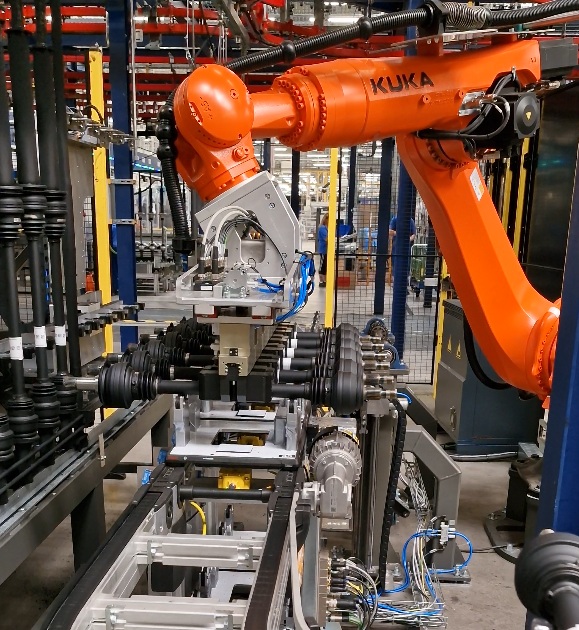
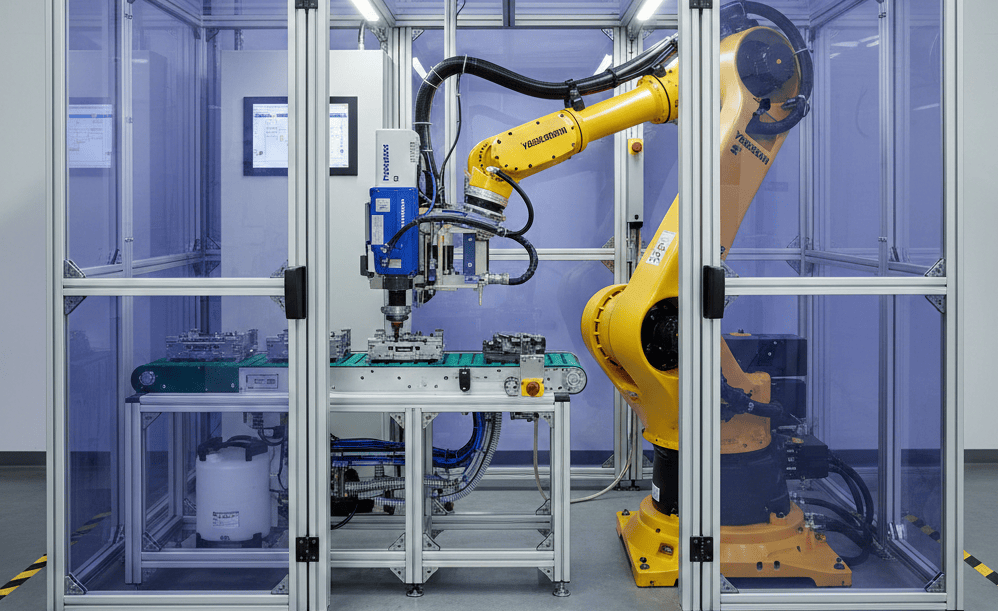
Are you wondering what a cobot is and how it can revolutionize your production? It is a collaborative robot that combines the precision of a standard industrial robot with close human cooperation, becoming the key to modern automation. It can work hand in hand with a human, without fences, performing repetitive tasks and supporting production.
What is a cobot?
Cobot is short for “collaborative robot”, meaning a collaborative robot. Unlike traditional industrial robots, which often require dedicated safety zones and cannot interact with humans, cobots are designed to operate safely alongside workers. Their key feature is the ability to collaborate with people within the same work environment. This allows for combining the strength and precision of a machine with the flexibility and decision-making ability of a human. A cobot (collaborative robot) is an industrial robot designed for safe collaboration with humans in the same workspace, without the need for protective barriers.
Cobots are primarily distinguished by advanced safety sensors. These sensors allow the machine to detect human presence and react immediately, for example by slowing down or stopping movement to avoid collisions. Cobots are typically smaller, lighter, and easier to reprogram quickly than their larger counterparts. This flexibility facilitates integration with existing production lines and allows for adaptation to various tasks. Programming collaborative robots is also often intuitive, which shortens implementation time. As you can see, cobots have many advantages and can be effectively used in production automation.
Cobots are characterized by their lightweight construction, rounded shape, and advanced force, torque, and collision sensors, which enable immediate stopping in the event of contact with a human.
They are easy to program and do not require separation from the operator, unlike traditional industrial robots, which work behind barriers due to high force and speed.
What is a cobot used for? Examples of applications in industry and logistics
Cobots are widely used in many sectors of industry and logistics, where they can significantly streamline processes. Their versatility allows for performing tasks that require both precision and repeatability, while at the same time they can be monotonous or burdensome for humans. Thanks to their design and capabilities, cobots are becoming an invaluable tool supporting human work.
Cobots in CNC machine operation
In the case of CNC machines, cobots prove exceptionally effective in automating the processes of loading and unloading workpieces. This allows for increased machine uptime, as the robot can continuously supply new elements for processing. The operator can focus on process supervision and tasks requiring more attention. Importantly, the cobot is safe for the employee, even when working in direct proximity to the processing zone, which eliminates the need for barriers.
Cobots and the plastics industry
In plastics processing, cobots are used to remove finished parts from injection molding machines. They can then perform additional operations, such as machining or packaging. They increase the efficiency of production lines by taking over repetitive tasks. The use of cobots in this industry significantly increases the production efficiency of plastic products.
Is a cobot a robot? Differences and similarities
The answer to the question of whether a cobot is a robot is: yes, a cobot is a specific type of robot. It should be seen as a subcategory of robots, designed with a different operating philosophy in mind. The fundamental similarity is their ability to automate tasks and perform repetitive actions. The key difference, however, is safety and the possibility of close human-robot interaction, which distinguishes a cobot from traditional industrial robots.
Here is a summary of how a cobot differs from an industrial robot:
| Aspect | Cobot | Industrial robot |
|---|---|---|
| Security | Collision sensors, force limiters; no barriers | Requires cages and separation |
| Construction | Lightweight, flexible, often 6-axis | Massive, fast, strong |
| Programming | Simple, intuitive | Complex, specialist |
| Workspace | Shared with man | Isolated |
Cobots are industrial robots that comply with ISO standards (e.g., ISO 8373:2012), but with collaborative modes: they stop on contact, slow down on approach, or limit speed in selected zones. There is no “pure” cobot – it is always a system collaborating with tools, sensors, and software, enabling safe interaction. The ISO standard emphasizes that a cobot operates only in a partially shared space, with automatic resumption after human withdrawal.
The role of cobots in the evolution of the labor market
The growing use of cobots heralds a transformation of the labor market in industry. Instead of replacing employees, cobots often change the nature of their work, taking over tasks requiring physical effort and monotony. Employees can focus on more complex activities, such as process supervision, programming, or quality control. This opens the way for the creation of new jobs and the development of competencies related to the operation and integration of advanced robotic systems.
- Cobots are used in many industries, such as automotive, electronics, the food industry, or the pharmaceutical industry.
- Due to their flexibility and precision, they can perform tasks from assembly, through packaging, to palletizing.
- Cobots are designed to work alongside people without the need for additional safeguards or protective cages, which increases production efficiency.
- Many cobots offer intuitive user interfaces that allow for quick and simple programming, even without advanced knowledge of robotics.
- Modern cobots are equipped with advanced safety systems, such as force and torque sensors, which allow for the immediate stopping of the robot in case of contact with a human, minimizing the risk of injuries.
The future of human-machine collaboration is based on synergy, where cobots serve as a tool supporting human capabilities. This requires employees to be flexible and ready to adapt to a dynamically changing production environment. It is precisely in this synergy that the potential for further development of industry and logistics lies.
Largest cobot manufacturers
The choice of the right device depends on the specifics of production, however, the market is dominated by several key brands that set standards for safety and ease of use. When choosing collaborative robots, it’s worth paying attention to the offerings of leaders:
- Universal Robots (UR): Danish pioneer and global leader, who was the first to introduce cobots to the market. Their UR series models (e.g., the latest UR20 with AI Accelerator) are valued for the huge ecosystem of UR+ accessories and incredibly simple [robot programming].
- FANUC: A Japanese giant known for reliability. Their CRX series (characteristic white arms) combines industrial durability with sensitive safety sensors, making them ideal for working in tougher production environments.
- ABB: Swiss manufacturer offering innovative solutions, such as the two-armed YuMi cobot or the GoFa series. ABB focuses on deep integration with artificial intelligence and vision systems.
- KUKA: German precision encapsulated in models such as the LBR iisy. This company focuses on high sensitivity and advanced collaboration in industries requiring delicacy, e.g., in electronics or laboratories.
- Yaskawa: Manufacturer of the Motoman HC series, which stands out for its high resistance to dust and water (IP67 class), allowing cobots to operate in environments where other machines might fail.
Interesting facts about cobots
- The term cobot is a combination of the English words “collaborative” (cooperating) and “robot”. The first commercial model was introduced by the Danish company Universal Robots, which is the largest player in this market.
- The cobot concept was born in 1996, and early models were presented by, among others, the KUKA company.
- In the automotive industry, for example at General Motors, cobots assist employees in repetitive tasks, without completely replacing them.
- Alternative names are corobots, assistant robots, or cobots.