A shortage of workers and the growing pressure to achieve the shortest possible order completion times are today the everyday reality faced by most manufacturing plants. Finding a qualified worker for the position of welder borders on a miracle, and the market does not forgive delays or quality shortcomings. All this forces companies to seek new technological solutions and robotic welding has become an integral part of modern manufacturing plants, allowing for a significant increase in efficiency and greater flexibility in process planning.
In separate articles you will also read about this, what is automation in industry and why has it become a necessity and you will learn more about process robotization in the automotive industry.
- What does the robotization of welding consist of?
- What benefits does the robotization of welding processes bring?
- Methods of robotic welding and welding applications
- Architecture and forms of organization of welding stations
- The role of components in the robotic welding cycle
- What do you need to refine before you think about robotizing welding?
- FAQ – Frequently Asked Questions
What does the robotization of welding consist of?
Robotic welding involves replacing manual labor with an automated mechanical arm integrated with a welding power source. A key element of this technology is the full synchronization of the robot’s precise movements with the electrical parameters of the arc. The essence of the process is continuous bidirectional communication between two key control units:
- Digital controller of the welding power source: A microprocessor-based unit embedded in the welder that responds to signals from the robot controller and continuously adjusts the voltage, current, and wire feed speed, adapting the arc dynamics to the current position and speed of the tool.
- Robot controller: Manages the arm’s trajectory in 3D space. It is responsible for micro-movements, maintaining a constant travel speed, and precisely maintaining the torch’s inclination angle relative to the joint.
Automation of production processes through the use of industrial robots guarantees excellent quality and repeatability of welds, eliminating any deviations and errors caused by the human factor that occur in the manual process of traditional welding.
What benefits does the robotization of welding processes bring?
The implementation of robotic welding forms the foundation of modern production — it is a strategic investment that allows for the elimination of bottlenecks and a direct improvement in the plant’s competitiveness. The main advantages of robotic welding are:
- Compensation for dimensional inaccuracies of parts: Tolerance deviations after laser cutting or bending and thermal deformations pose a significant challenge in welding. Robotic systems use an advanced touch sensor (Touch Sensing) and dynamic real-time arc weld seam tracking (TAST – Through-Arc Seam Tracking). Analysis of changes in electrical current parameters enables automatic correction of the torch trajectory, which ensures process stability even with variable gap geometry.
- Optimization of material usage and cost reduction: In the manual process, a common mistake is creating too large allowances at the joint, which leads to uncontrolled consumption of wire and shielding gas. The robot precisely dispenses additional material strictly according to the design guidelines, which increases efficiency, lowers raw material costs and reduces the amount of waste.
- Limitation of heat input and elimination of finishing operations: Welding thin-walled components is associated with a high risk of distortion and burn-throughs. The use of robotic low-temperature processes, such as CMT (Cold Metal Transfer), involving controlled cyclic retraction of the wire, enables braze-welding of galvanized sheets and the joining of thin components with a minimal heat-affected zone and no spatter.
- Minimization of downtime thanks to offline programming: Programming welding robots directly on the shop floor requires stopping the entire production line. 3D simulations allow an engineer to design the robot’s entire path on a computer – without interrupting the factory’s operation. Thanks to the precise representation of the tool (TCP – Tool Center Point), after uploading the finished program to the robot it is sufficient to run tests.
- Ensuring consistent quality and compliance with standards: Meeting rigorous quality requirements in manual processes requires constant monitoring. The digital welding power source logs process parameters for each joint. This guarantees full compliance with the WPS technological instruction (Welding Procedure Specification) and traceability for audit purposes.
- Raising occupational health and safety standards and operator safety: Automation and robotization enable the isolation of personnel from hazardous environments (UV radiation, high temperatures, toxic fumes). The use of integrated functional safety systems (e.g. SafeOperation, SafeMove, DCS) in combination with laser scanners and safety curtains allows the creation of a safe welding workstation compliant with ISO 10218, where the operator only supervises the cycle.
- Stabilization of the production cycle and operational continuity: Employee turnover and staff shortages are a major challenge to the stability of the production line. Implementing robots provides a steady, predictable rhythm of work, which actually increases productivity and shortens the payback period of the investment.
Methods of robotic welding and welding applications
The choice of the appropriate manufacturing technology is a key stage in designing an automated workstation. Although MIG/MAG welding has remained the most commonly chosen standard in industry for years, robotization systems encompass a much broader portfolio of processes. The selection of the proper solution is dictated by the material specifications, the required throughput, and the project’s budget.
| Method / Technology | Characteristic features | Main applications in industry |
| Arc welding – MIG / MAG | High melting efficiency, versatility and very good penetration depth at relatively low costs. | Standard in steel structures, agricultural machinery, the construction industry and the chassis-and-semi-trailer sector. |
| Arc welding (TIG) | Exceptional aesthetics and precision in the arc zone, excellent control over the introduced heat. | Thin-walled components made of stainless steel, aluminium, food industry, HVAC installations. |
| Spot welding and welding | Built on resistance welding. Ultra-short cycles, powerful clamping force and zero need for filler. | The main choice in automotive welding shops (body panel connections on production lines). |
| Laser welding | Ultrafast process with a microscopic heat-affected zone. No distortions and deep penetration. | Precision automotive components, medical industry, covers and housings with high visual rigor. |
| Specialized welding (projection welding, friction welding) | Utilization of the phenomenon of friction or electrical resistance for highly repeatable joining of difficult parts. | Mass production of connectors, shafts, fasteners and components made of difficult-to-weld alloys while maintaining a short production cycle time. |
Architecture and forms of organization of welding stations
The automation of welding processes is not limited solely to traditional goals. To effectively automate or robotize the manufacturing process, various design variants are used, adapted to the dimensions of the hall and the specifics of the parts.
| Variant of the position | Technical characteristics | Main application |
| Fenced welding cell | Closed area with a fast industrial robot. Requires physical enclosures, locks and curtains. | Mass and serial production, high work pace. |
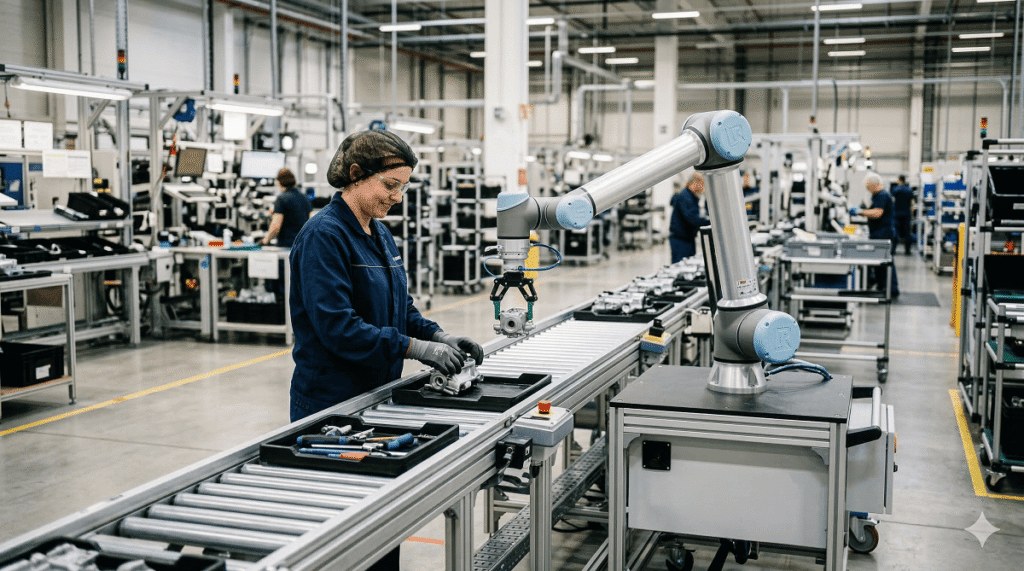
| Workstation with a cobot | An open workstation where a collaborative robot, a welding cobot, works. Innovative robots of this type have collision sensors for working next to a human. Discover the benefits of cobots in our separate article. | Small and medium series, flexible change of assortment, small area. |
| Gate systems and trackways | A welding robot suspended on a gantry or moving along rails, which drastically increases its range. | Large-scale structures: bridge spans, railcar bodies, ships. |
| Dedicated machines | Machines designed for a single dedicated shape, lacking a 6-axis arm, e.g. automated rotary tables. | Repetitive circumferential and straight-line welds (pipes, tanks). |
| Welding carts and tractors | Small self-propelled devices moving on rails or magnets directly on the welded material. | Welding long seams in the field, in shipyards and in the petrochemical industry. |
| Mobile systems (AMR + Cobot) | Autonomous mobile robot transporting a welding cobot to various points of the factory. | Very flexible production in large industrial halls. |
The role of components in the robotic welding cycle
In modern industry, robotic welding is much more than the mechanical replacement of a welder’s hand. It is a fully integrated technological ecosystem in which the arm’s kinematics are coupled with the dynamics of the electric arc, workpiece locating systems and safety automation. As a result, each joint is created in strictly controlled, repeatable thermal and current conditions.
- PLC controller: The supervisory automation unit managing the entire work area. It monitors safety systems (scanners, light curtains), controls the fixturing of parts (pneumatic/hydraulic clamps), and exchanges data with production management systems (MES/ERP).
- Robot/cobot controller: The computer responsible for precise guidance of the tool in 3D space, maintaining a constant feed rate, and real-time digital contact with the power source. In the case of collaborative robots, it additionally allows intuitive programming by manually guiding the arm (lead-through).
- Vision systems and sensors: An advanced measurement system that, before the start of the cycle, locates the workpiece and corrects the trajectory, during the cycle — tracks the weld with an arc in real time, and after completion — automatically verifies the quality and continuity of the joint.
- Digital welding power source: Power supply device supplying current with precisely defined parameters (voltage, current, arc dynamics), adjusted to the speed of the arm’s movement.
- Final tool: Light welding equipment mounted at the end of the arm — most often a torch (MIG/MAG, TIG), a laser head, or spot-welding tongs.
- Automatic wire feeder: Mechanism responsible for the smooth and slip-free delivery of welding wire through the cables directly to the torch.
- Automatic cleaning station: A service device that, during breaks between cycles, cuts spatter from the torch nozzle, trims the contaminated end of the wire, and applies anti-spatter agents.
- Positioners and rotators: Automated rotary tables connected to the controller that position the part in the optimal welding position in full synchronization with the movement of the arm.
What do you need to refine before you think about robotizing welding?
Effective robotization of the welding process requires proper preparation of the entire technological process chain. Treating the robot as a ‘cure’ for existing quality problems is the most common investment mistake. Before the first robotic welding systems are introduced into the plant, several key areas need to be refined.
- Quality and dimensional repeatability of parts: This is the most important necessary condition. If the edges of the parts arriving at the workstation are not precisely prepared, the robot guiding the torch along the programmed path will encounter an empty gap or burn through the material. Before you plan welding automation, you must tighten the rigor of tolerances at the stage of laser cutting, punching and bending on press brakes.
- System for locating and clamping parts: Every detail must be located at exactly the same spatial coordinates. It is necessary to design rigid, repeatable clamping fixtures (jigs), preferably equipped with quick-acting pneumatic or hydraulic clamps that stabilize the material and ensure consistent heat dissipation.
- Control of thermal deformations: Robotic welding is characterized by high dynamics and cumulative heat input. Without a previously developed, precise sequence for depositing welds, thermal stresses can deform the finished part beyond acceptable dimensions, regardless of how perfectly the arm guided the torch.
- Adjustment of series structure and hall logistics: You should carefully analyze how the plant operates. Automation pays off most quickly in mass and serial production. If the plant runs short, variable batches, processes should be planned before implementation to avoid wasting time on constant machine changeovers.
- Preparation of staff and redefinition of roles: Process automation changes the profile of required competencies. Before implementation, the plant must designate and train employees who will supervise the robotic process. These people must combine practical welding knowledge with the ability to operate the robot’s control panel.
Optimal technological decisions always depend on the specifics of the particular production. An excellent example of this approach is handling dimensional deviations: while in light sheet-metal processing and high-volume production it is most cost-effective to eliminate errors at the source (during cutting or bending), with very large dimensions, castings, or small batches forcing perfect material precision before the robot would incur absurd costs. In such an environment, investing in advanced sensors or 3D scanners often proves to be a far cheaper option. Thus, the key to success is not an unconditional fight for textbook perfection at every stage, but flexibly choosing solutions precisely where they will deliver the lowest total cost and allow full use of the benefits of robotization.
If you plan to implement robotization, in a separate post we advise which industrial robot supplier to choose for your facility.