A modern automotive plant resembles a perfectly tuned orchestra in which various sections of instruments play. The same is true of machines – efficient production requires integration of industrial robots with vastly different payload, reach and motion dynamics parameters. On the production floor there is no single universal solution, and selecting the appropriate kinematics is the most important aspect of planning any automation investment. For leaders of the automotive industry robotization of production it’s no longer a matter of prestige, but the only way to maintain price competitiveness and rigorous quality standards. From our article about robotization of processes in the automotive industry, you will learn which processes are worth automating and what benefits and challenges are associated with this process. In a separate post we also explain, what industrial automation is and why has it become a necessity in today’s market realities.
- Articulated and Cartesian robots as the foundations of heavy manufacturing
- SCARA robots in precise assembly of automotive electronics
- Cobots as safe support for humans
- Mobile AGV and AMR robots for factories without conveyor belts
- Delta robots – kings of ultra-fast sorting
- Summary
- FAQ – Most Frequently Asked Questions
Articulated and Cartesian robots as the foundations of heavy manufacturing
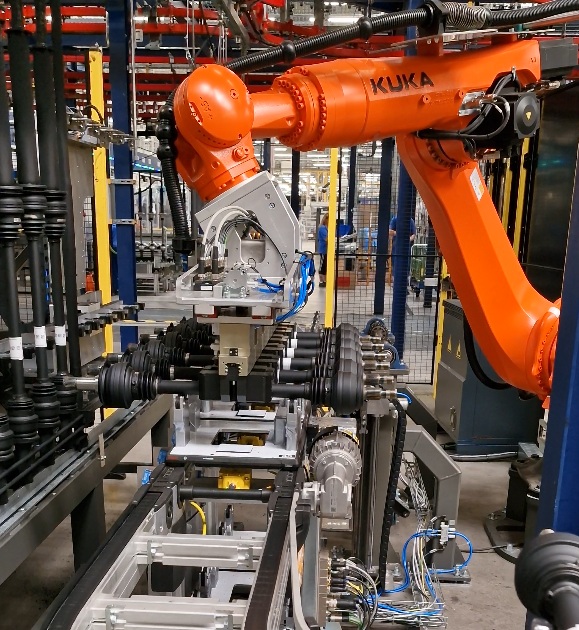
Six-axis articulated robots are true athletes and versatile soldiers in one. They dominate wherever an object needs to be manipulated at any angle — they are indispensable for welding and painting complex vehicle body shapes because they can reach the hardest-to-reach places inside the vehicle body. By contrast, Cartesian robots, which mostly move along straight linear guides, form the backbone of transport systems. They are widely used in “pick and place” applications to rapidly feed smaller components directly over conveyor belts.
If you plan to implement such giants, on our blog we suggest, which industrial robot supplier to choose for your plant, to ensure trouble-free implementation and service.
SCARA robots in precise assembly of automotive electronics
A modern car is essentially a powerful computer on wheels. SCARA robots are ideal for assembling electronics. Their design is based on two rotating links operating in the horizontal plane and one performing vertical motion. This unique structure gives them incredible speed, rigidity, and repeatability of positioning along the vertical axis. It is with their help that delicate electronic components, advanced sensors, digital gauges and cockpit panels are produced. With such microscopic details the margin of error is practically zero, and precise robot programming allows for flawless reproduction of the motion trajectory in fractions of a second. Learn more about SCARA robots in our blog post, “What is a SCARA Robot? Working Principle, Advantages, and Applications.“.
Cobots as safe support for humans
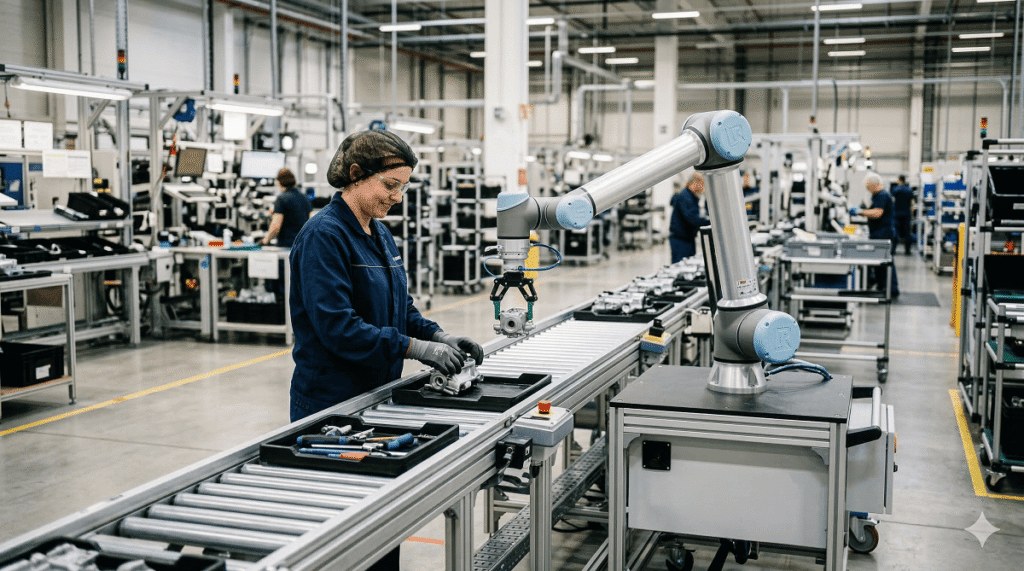
Cobots are a relatively young but revolutionary branch of robotics. They are designed to work side by side with humans without the need to build large cages and protective barriers around them. For those who are just getting to know this technology, we have prepared a post explaining what a cobot is. In the automotive industry these machines have become a brilliant assistant to humans. They support operators with the most repetitive and tedious tasks, such as tightening dozens of screws with identical force, precisely placing gaskets or fitting small assembly clips. In a separate article we also discuss, the most important advantages of cobots and we answer the question How much a cobot costs.
Mobile AGV and AMR robots for factories without conveyor belts
Although robotic arms mainly catch the eye, modern plants are intensively investing in mobile robots – AGVs and AMRs. These autonomous transport platforms are displacing traditional forklifts. They circulate the halls, delivering components to the assembly line exactly on time. In the most advanced factories it is precisely on AMR platforms that entire chassis are built – the car “rides” through successive assembly stations on the back of the mobile robot, which gives the factory unprecedented flexibility in reconfiguring production. You can learn more about mobile robots in our article: “AGV and AMR Mobile Robots in Industry – What Is the Difference Between an Autonomous Robot and a Guided Vehicle?“.
Delta robots – kings of ultra-fast sorting
Where SCARA robots prove too slow, Delta robots step in, called spiders because of their characteristic appearance. Their arms are mounted above the production line on a common base. Thanks to their parallel construction they have minimal mass of their own, which allows them to achieve dizzying accelerations. In the automotive industry they are used for lightning-fast sorting and packing of small parts – from fuses and light bulbs to small mechanical components, often working with advanced vision systems that identify the position of the part in a fraction of a second. Learn more about Delta robots in our article “Delta robots in industrial automation: design, applications & high-speed benefits“.
Summary
The differences between the technologies described are easiest to discern by comparing them directly with one another. In the table below we have compiled the key design features and the tasks that the individual units perform in a modern production plant.
| Type of robot | Main feature / Kinematics | Key tasks in the factory | Business benefit |
| Articulated 6-axis | Maximum range, work at any angle | Welding and painting of complex vehicle body shapes | Versatility and access to hard-to-reach places |
| Cartesian | Movement along straight linear guides | Applications of the type pick and place, quick provision of details | Stable backbone of transport systems |
| SCARA | High stiffness and repeatability in the vertical axis | Assembly of electronics, sensors, displays and digital clocks | Surgical precision with microscopic details |
| Cobot (Collaborative) | Safe work side by side with a human without cages | Tightening screws, fitting gaskets, mounting clips | Relieving operators of tedious tasks |
| Mobile (AGV / AMR) | Autonomous mobile platforms | Component transport, movable chassis assembly lines | Flexible logistics, a factory without traditional conveyor belts |
| Delta (“Spider”) | Parallel structure of minimal self-weight | Ultra-fast sorting and packing (fuses, light bulbs) | Dizzying accelerations and cycle time savings |