The VASS standard is the Volkswagen Group automation standard that defines how machine suppliers and integrators build the hardware, the PLC program, the visualisation and the line documentation for the Group’s plants. It applies to anyone who programs or commissions controllers in the factories of Volkswagen, Audi, Seat and Škoda. It gives the supplier ready-made libraries and a uniform project structure, but the supplier must follow strict rules for using them and provide a team with proven qualifications.
What does VASS stand for, and what is the VASS standard?
The abbreviation VASS comes from the names of four Group brands: Volkswagen, Audi, Seat and Škoda. In practice it is a set of rules and libraries according to which the automation of production lines in Volkswagen Group plants is built.
Volkswagen develops the standard in successive generations. The sixth one, known as VASS V6, replaced version V5 and covers the entire project chain:
- hardware and control cabinets: libraries for the Eplan software, including 3D functions and the Rittal VX25 cabinet system;
- data exchange between the electrical project in Eplan and the controller project in TIA Portal via the AML interface (hardware configuration, inputs and outputs, network topology);
- the PLC program and HMI visualisation, i.e. libraries of blocks and screens;
- documentation and training materials.
The standard is used by machine suppliers, integrators and commissioning companies working for the Group’s plants, including on lines for the MEB electric platform. The aim is that in a plant where machines from many suppliers work side by side, all the automation is built to a single pattern.
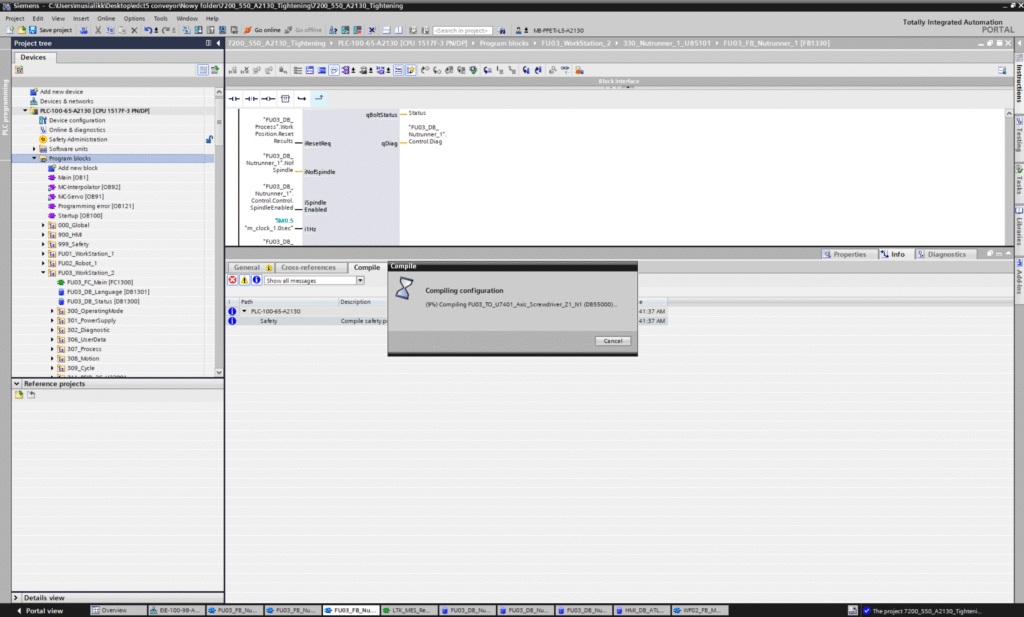
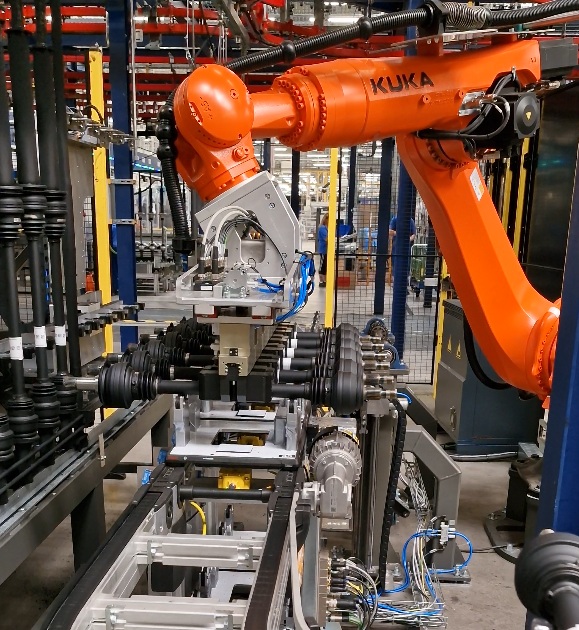
We programmed and commissioned Siemens S7-1500 controllers for Volkswagen plants, among others on the ACT EVO Hood assembly line in Salzgitter and at the rework stations of the Flexible line in Polkowice. In the latter project the control logic was developed in line with Volkswagen standards. The scope of work we perform in such projects is described on the page about PLC programming in the VASS standard.
VASS is not the only corporate standard in the automotive industry. Daimler (Integra) and BMW (TMO) also develop their own standards, each with separate libraries and supplier requirements.
What does the VASS V6 standard consist of?
The VASS V6 standardization guideline divides the software part of the standard into four components: the program library in STEP 7, the visualisation in WinCC Advanced, the SiVArc screen generation rules and the documentation. All of them are created in the TIA Portal environment, and the program runs on Siemens controllers such as the S7-1500.
| Component | What it contains | Significance for the project |
|---|---|---|
| STEP 7 | function blocks (FB), data structures (UDT), device catalogues | the program is assembled from ready-made standard blocks rather than blocks written from scratch |
| WinCC Advanced | faceplates and detail screens of devices | the operator sees a drive or a clamp in the same form at every station |
| SiVArc | rules that generate HMI screens from the PLC program and libraries | the visualisation results from the program, so an error in its structure carries over to the screens |
| Documentation | block help files, hardware configurations, parameterisation descriptions | the supplier hands over documentation in the structure defined by the standard |
Terms used in the table:
- Function block (FB): a fragment of the program with its own data memory that controls one module of the machine, for example a drive, a clamp or a conveyor.
- UDT: a user-defined data type that gathers the signals of a single device into an orderly structure.
- Faceplate: a ready-made HMI screen object linked to a block in the controller.
- SiVArc: a Siemens extension that creates the visualisation automatically from program blocks, screen libraries and rules.
For work in the V6 standard, the guideline provides for the STEP 7 Professional, WinCC Advanced and Safety Integrated packages and for tools for configuring SINAMICS drives. HMI screens are created in several languages, including German, English, Spanish and Chinese, because the same line may end up in a plant in another country.
What does the VASS standard require from a PLC programmer?
The VASS standard requires a PLC programmer to hold a qualification confirmed by a Volkswagen Bildungsinstitut certificate. According to the institute, the certificate is a condition for programming and commissioning Siemens controllers in line with the applicable standard in the Group’s plants. The V6 guideline also requires the supplier itself to have completed TIA Portal training and to have sufficient knowledge of the VASS standard and of Volkswagen’s production technology.
The “Inbetriebnehmer SPS Siemens, VASS V6” qualification is run by Volkswagen Bildungsinstitut in Zwickau. The course is aimed at software and electrical designers, commissioning engineers and plant suppliers, and its programme covers:
- planning the hardware configuration according to VASS;
- safety programming and the rules for program structure;
- standard programming based on data structures;
- an overview of the function block libraries and the definition of the address space;
- programming step chains;
- generating the visualisation with SiVArc and the message system.
The course teaches the standard itself, not how to use the environment, so the institute expects participants to already know TIA Portal, the SCL and S7-Graph programming languages, the PROFINET network and the programming of safety functions in Distributed Safety.
Independently of the Volkswagen qualification, Siemens SITRAIN runs a VASS 6 workshop for integrators and machine manufacturers (OEMs), intended for people who plan, configure, commission and maintain TIA Portal projects according to VASS V6.
What risks does a VASS project carry when run without experience?
The biggest risk is a program that controls the machine correctly but does not meet the requirements of the VASS standard. Such code has to be corrected before acceptance, and if the non-conformity is found only during commissioning, the rework falls in the period when the line should already be entering production ramp-up.
A non-conformity can arise in three places that the standard regulates explicitly.
Modifying a standard block. When a library block does not support an unusual device, the simplest option would be to add your own logic to it. However, the V6 guideline allows changes and new standard blocks only after consultation with and approval by Volkswagen’s electrical department, so a modification made without that consent has to be reversed. That is why a deviation is agreed with the customer before the code is written.
Hand-drawn HMI screens. In VASS V6 the visualisation is generated by SiVArc, so a change made by hand survives only until the next generation, after which it disappears or stops matching the program. Corrections are therefore made in the program or in the generation rules, not directly on the screen.
A custom program structure. The standard defines the division of the address space, the structure of step chains and the message system. A program with its own address layout or its own sequence logic will not pass the conformity check and will have to be rebuilt.
For the project this means:
- acceptance held up until the non-conformities are removed;
- rework of the program and visualisation during commissioning;
- additional arrangements with the customer’s electrical department that could have been avoided at the design stage.
The cost of non-conformity with the VASS standard grows with every project stage: a program correction made at the design stage is cheaper than the same change made on the shop floor during commissioning.
Are you building a line or a station for a Volkswagen Group plant and need a team that knows the VASS standard? Write to us, we will check the specification, prepare the PLC program and visualisation according to the standard’s libraries and commission them on site.
How does the VASS standard affect line acceptance and maintenance?
The VASS standard sets the scope of line acceptance and, after commissioning, makes the line easier to maintain throughout its service life. The customer checks conformity with the standard in three areas:
- program: blocks from the standard library, agreed deviations, the structure of addresses and sequences;
- visualisation: screens generated from the program and a complete set of language versions;
- documentation: block help files, hardware configuration and parameterisation in the structure defined by the standard.
In a VASS project, the signals checked during the input and output test are also laid out according to the standard’s address space.
After acceptance, maintenance benefits from the uniformity of the standard. The program structure, screens and documentation look the same at every station, so a technician always looks for a signal, a sequence step or a message in the same place, regardless of which supplier built the machine.
Planning a project for a Volkswagen Group plant and want to know what the VASS standard requires in your specification? Write to us, we will analyse the requirements and point out where the project needs arrangements with the customer.
FAQ
Sources
- Design Solutions, “Volkswagen releases VASS standard which includes EPLAN Version 2.9”: https://designsolutionsmag.co.uk/volkswagen-releases-vass-standard-which-includes-eplan-version-2-9/
- Maschinenbau Journal, “VASS-Standard jetzt um 3D-Funktionalität und neueste Schaltschranktechnik erweitert”: https://www.maschinenbau-journal.de/2020/07/29/vass-standard-jetzt-um-3d-funktionalitaet-und-neueste-schaltschranktechnik-erweitert/
- Volkswagen, “VASS V6 Standard – Standardization Guideline” (standardization guideline, version 1.0).
- Volkswagen Bildungsinstitut, qualification “VASS V6 Qualifizierung Inbetriebnehmer SPS Siemens”: https://www.vw-bi.de/kursangebot/kursfinder/detailansicht-kurs/volkswagen-1283/vass-v6-qualifizierung-inbetriebnehmer-sps-siemens-2.html
- Siemens SITRAIN, VASS 6 workshop for integrators and OEMs: https://www.sitrain.us/lms/DES/SCT-VAOILS6OEE.PDF