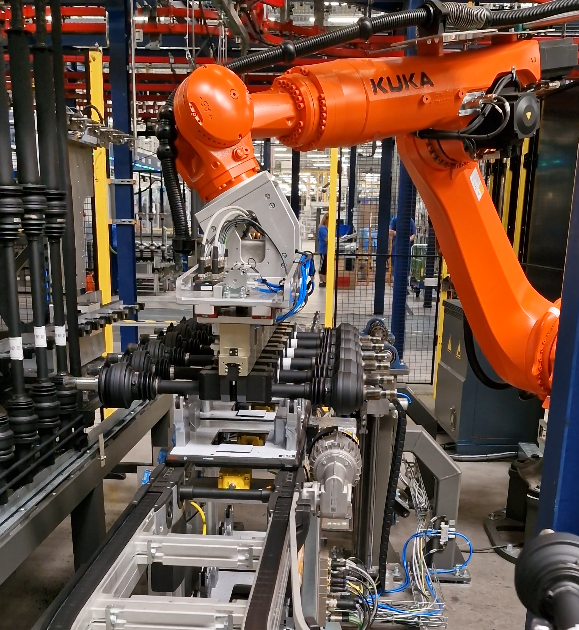
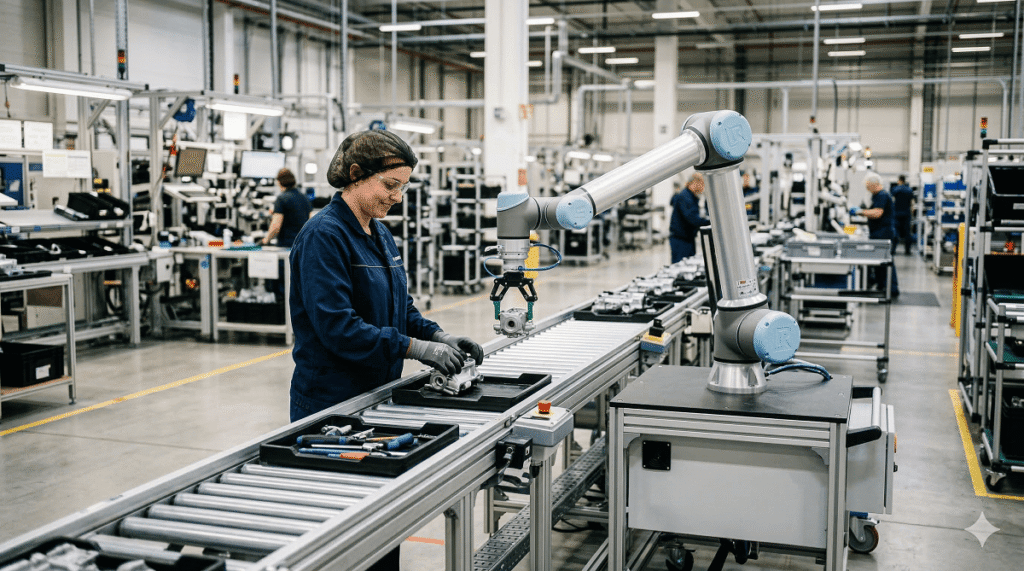
A Programmable Logic Controller, commonly known as a PLC, is the foundational “heart” of modern industrial automation. These microprocessor-based systems—which have largely replaced traditional, legacy hard-wired relay-contact logic—are designed to control individual machinery and entire production lines. Through programmed algorithms, a PLC cyclically processes signals from sensors, pushbuttons, and process instrumentation to generate execution commands for actuators, such as motors, solenoids, and valves.
PLC Architecture
Think of a typical PLC controller as a specialized computer designed to operate in harsh, industrial conditions. Its construction is designed to ensure maximum reliability. It consists of several key modules that work closely together to perform the given control functions. To learn more about the technical details of individual components, check our detailed entry on what a PLC controller consists of.
Power Supply Module
The Power Supply is the backbone of the unit, providing stable DC voltage to all internal components. Its primary role is to filter electrical noise and protect against voltage surges, which is critical for maintaining system integrity and operational continuity.
Central Processing Unit (CPU)
The CPU is the “brain” of the PLC. It executes the user program, processes incoming input data, and triggers the corresponding output signals. The microprocessor is responsible for performing all arithmetic and logic operations required to solve the control algorithm and make real-time decisions based on programmed instructions.
Memory
Memory is essential for storing the firmware (operating system), the user application, and runtime data. RAM: Serves as the volatile operational memory where variables and logic states are processed during execution. ROM/Flash: Holds the system software and the retentive user program.
Input/Output (I/O) Modules
The I/O modules serve as the interface between the PLC and the physical world. Signal Types: These can be Digital (discrete) or Analog. For analog signals, an Analog-to-Digital Converter (ADC) is utilized to translate continuous electrical signals into a digital format the processor can interpret. Input Modules: Receive signals from sensors and field devices, providing the CPU with real-time process status. Output Modules: Execute the CPU’s commands by driving actuators like motors or valves.
PLC Operating Principle
The operating principle of a PLC is based on a repetitive work cycle. It ensures continuous process monitoring and response to changing conditions. This cycle is fundamental to understanding how a PLC works in practice. The processor executes a programmed algorithm, analyzing input data and generating appropriate output signals.
Read Inputs and Memory State
At the beginning of each cycle, the controller reads the current signal states from all input modules. Simultaneously, it retrieves the necessary data from the operational memory. In this way, it gathers information about the process state to make appropriate decisions.
User Program Execution
Next, the controller proceeds to execute the program you have prepared. The processor processes instructions step by step, according to the logic of the algorithm stored in memory. All arithmetic and logical operations are performed to determine what the future output states should be.
Write Outputs and Communication
In the final phase of the cycle, the controller updates the states of the output modules based on the performed calculations. At the same time, it can establish communication with other systems, such as industrial computers, through available communication ports like Ethernet or RS-232, exchanging the required information.
Types of PLC Controllers
There are many types of PLC controllers available on the market, which can be classified in various ways—based on their design, intended use, or capabilities. Choosing the correct type of controller is absolutely critical for the efficiency of the entire automation system. Let’s look at the basic categories.
Compact Controllers
Compact controllers are integrated devices. This means that the power supply, processor, and input and output modules are all contained within a single housing. They are characterized by simplicity of installation and configuration, as well as lower cost. They perform excellently in smaller applications and simpler control tasks.
Modular Controllers
Modular controllers provide much greater flexibility. They consist of a chassis, or mounting rail, to which you can connect various modules: processor, power supply, input modules (digital and analog), output modules, as well as communication modules. This design allows for the creation of extensive systems and the precise tailoring of the controller to specific application needs. Furthermore, modern PLC controllers allow for multiple expansions by simply adding more modules.
Specialized Controllers
In addition to standard controllers, specialized models can also be found. Safety controllers (safety PLCs) ensure the highest level of protection for operators and machinery, while motion control controllers are dedicated to the precise control of drive axis movement.
PLC Programming – Languages and Tools
PLC programming is the process of creating control algorithms that define how the controller is to operate. To facilitate this, several standard programming languages have been developed, and manufacturers provide dedicated software. Programming a PLC is a key stage of configuration and the subsequent operation of the entire system (production line, machine).
Standard PLC Programming Languages (IEC 61131-3)
The international IEC 61131-3 standard specifies five basic PLC programming languages. These are: LD (Ladder Diagram), FBD (Function Block Diagram), ST (Structured Text), SFC (Sequential Function Chart), and IL (Instruction List). The choice of a specific language usually depends on the complexity of the task and the programmer’s personal preference. We have described more about the individual languages in the post: what are the PLC programming languages.
Programming Tools – Integrated Development Environments (IDE)
Advanced Integrated Development Environments (IDEs) are used to create, test, and upload programs to a PLC. Modern software of this type has evolved from simple code editors into powerful engineering platforms that integrate hardware configuration, logic programming, HMI interface design, and even drive parameterization.
Such environments allow engineers to:
- Write code in one of the five standard languages of the IEC 61131-3 standard.
- Perform hardware configuration – defining the physical structure of the controller, I/O modules, and communication cards.
- Simulate program operation (offline) – a key stage that allows for testing the algorithm logic on a virtual controller before connecting the physical device, which significantly reduces the risk of errors during commissioning.
- Perform debugging and diagnostics – monitoring variable states in real-time, forcing states, and analyzing CPU errors, usually using high-speed Ethernet (Industrial Ethernet) or USB ports.
Most Popular Programming Platforms on the Market
Each of the leading PLC manufacturers provides dedicated, proprietary software that forms the heart of its ecosystem. Below are the 3 most popular environments.
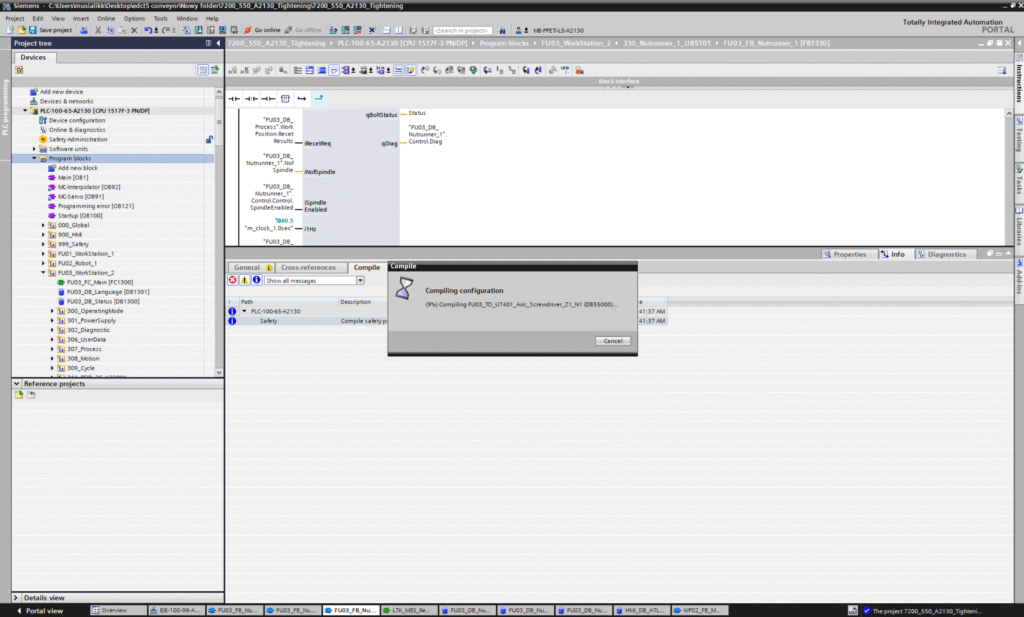
Siemens: TIA Portal (Totally Integrated Automation Portal) This is currently one of the most comprehensive and influential engineering environments in the industry. TIA Portal integrates tools for controller programming (SIMATIC Step 7 for the S7-1200, S7-1500, S7-300/400 series), visualization (WinCC for HMI panels and SCADA systems), and drives (Startdrive) into a single platform. Its key advantage is a common database for all devices in the project, which eliminates the need to enter the same variables multiple times and significantly speeds up work on complex systems.
Rockwell Automation (Allen-Bradley): Studio 5000 Logix Designer This environment is the standard in North America and in many global corporations. Studio 5000 is used to program controllers from the Logix family (ControlLogix, CompactLogix). It is characterized by an object-oriented approach, which facilitates the creation of modular, reusable code, and excellent integration with advanced motion control systems.
CODESYS (Controller Development System) Unlike the above, CODESYS is not tied to a single hardware manufacturer. It is an open, independent environment used by over 400 manufacturers of automation devices worldwide (e.g., WAGO, Beckhoff, Schneider Electric in certain series, Eaton). For a programmer, this means that by learning one tool, they gain the ability to program hundreds of different types of controllers.
Most Popular PLC Manufacturers
The market is dominated by several giants whose solutions set the trends for the development of modern automation.
Siemens (Simatic Series)
The German powerhouse and absolute leader in the European market. Controllers from the Simatic S7 family (especially the S7-1200 and S7-1500 models) are the standard in many industrial sectors. PLC programming for Siemens takes place in the powerful, integrated TIA Portal environment, which allows for the configuration of not only the controller but also HMI panels and drives.
Rockwell Automation (Allen-Bradley)
The American counterpart to Siemens, dominating North American markets. Their flagship ControlLogix and CompactLogix series are renowned for immense performance in highly complex process systems. Users value them for the intuitive Studio 5000 environment and high reliability in the most demanding conditions.
Mitsubishi Electric (MELSEC Series)
Japanese precision and reliability. Mitsubishi controllers are extremely popular in serial machinery and the Asian industry. The iQ-R series or FX compact controllers are characterized by an excellent price-to-performance ratio and very fast logic processing times.
Schneider Electric (Modicon)
It is worth remembering that it was the Modicon brand that created the first PLC. Today, Schneider Electric offers modern Modicon M221, M241, and M251 series, which place great emphasis on network communication (IIoT) and ease of integration with energy management systems.
Other Significant Players
The PLC market also includes many other specialized brands:
- Beckhoff – a pioneer of PC-based control and the very high-speed EtherCAT protocol.
- B&R (ABB Group) – valued for advanced motion control and a modern approach to programming.
- Omron – a Japanese manufacturer strong in the fields of robotics and vision systems integrated with PLCs.
| Manufacturer | Flagship Series | Environment (IDE) | Main Applications | Key Advantage |
| Siemens | Simatic S7-1200, S7-1500 | TIA Portal | Discrete manufacturing, automotive, heavy industry | Massive ecosystem and market standard in Europe (easy to find specialists). |
| Rockwell Automation | CompactLogix, ControlLogix | Studio 5000 | Process industry, Oil & Gas, USA markets | Very strong drive integration and advanced network diagnostics. |
| Mitsubishi Electric | MELSEC iQ-F, iQ-R | GX Works3 | Machine building (OEM), electronics, robotics | Extraordinary component durability and very fast calculation cycles. |
| Schneider Electric | Modicon M241, M251, M580 | EcoStruxure Machine Expert | Infrastructure, waterworks, building automation | Excellent Ethernet/IP and Modbus TCP communication “out of the box”. |
| Beckhoff | CX8000, CX5000 (IPC) | TwinCAT 3 | Fast packaging, measurement systems, IoT | Based on Windows OS and EtherCAT protocol (highest timing precision). |
| B&R (ABB) | X20 System, Panel PLC | Automation Studio | Advanced packaging machines, printing | Perfect motion control and module flexibility. |
| Omron | CP2E, NX1P2, NJ/NX | Sysmac Studio | Assembly lines, vision systems, robotics | Full integration with vision systems and SCARA/Delta robots in a single software. |
History of PLC Controllers – From Relays to Advanced Automation
The history of PLC controllers is a fascinating story of evolution in the field of automation. Their creation was a response to the need for more flexible and easily modifiable control systems compared to traditional relay-based solutions.
Genesis from Relays to Programmable Logic
Traditional control systems based on relays were rigid and difficult to modify. Changing the operational logic required physical rewiring. The need to create something more flexible led to the development of PLC controllers, which utilized programmable logic to control machine operation.
The PLC Revolution and Further Development
The introduction of the first programmable logic controllers to the market in the 1960s revolutionized industrial automation. Since then, PLC controllers have undergone a long evolutionary path, becoming smaller, faster, more intelligent, and equipped with advanced communication functions.
Key Statistics and Facts Regarding PLC Controllers
| Aspect | Description |
|---|---|
| Origins | 1960s, automotive industry (General Motors), the first commercial PLC was the Modicon 084 (1969). |
| Scan Cycle | Closed loop: input scanning, program execution, output update – real-time response. |
| Standard | EN 61131 – digital electronic system for industrial environments with programmable memory. |
| Functions | Control, communication, self-diagnostics, timers, logical and arithmetic operations. |
| Applications | Production lines, robots, CNC machines, building automation (HVAC), logistics, food and chemical industries. |
| Construction | Processor, memory, input/output modules (digital, analog), communication ports. |
| Programming | IEC 61131-3 Standard: LD, FBD, ST, SFC, IL. |
| Advantages | Simplified wiring (up to 80% reduction), ease of modification, high reliability. |