The choice of a control platform determines the stability and maintenance costs of operation at a production plant for the next dozen or so years. This decision is directly linked to the choice of supplier, because the most important companies that make PLC controllers provide not only hardware, but entire, closed engineering ecosystems.
Why is the choice of a PLC manufacturer a key business decision?
Programmable logic controller PLC, it is an industrial microprocessor-based computer designed to control the operation of machines and devices. These devices are known worldwide as programmable logic controllers. In a modern production plant, this intelligent controller receives input signals from elements such as a temperature sensor or a safety button, processes them according to the loaded program, and then sends control signals to actuators, e.g. valves or motors. Industrial automation relies on the stability of these devices, because every unplanned interruption generates enormous financial losses.
By choosing a specific brand, a factory does not buy merely a single component, but enters into a full technological ecosystem. It includes the development environment, dedicated tooling software, technical support, training for engineers, and a spare parts distribution network. This choice also determines how easily automation systems will be integrated with higher-level structures such as SCADA or operator HMI panels.
Who dominates the market? The most popular manufacturers of PLC controllers
The most popular PLC controllers in the world are the devices from the Siemens SIMATIC series and the systems supplied by the American corporation Rockwell Automation under the Allen-Bradley brand. These two entities control a significant portion of global industrial installations, setting technological standards. The market structure is highly geographically polarized, which is of crucial importance when purchasing machines from foreign suppliers.
Siemens dominates European markets, where it is the standard in most factories. Allen-Bradley is the absolute leader in North America, and these systems are widely used in the heavy process industry. The Japanese manufacturer Mitsubishi Electric maintains a very strong position in Asia and in mass-produced machines supplied to global markets.. Other significant suppliers who offer PLC controllers with an established position are among others. Schneider Electric, Omron, B&R, Beckhoff, Fatek and Unitronics. In the area of machine safety, dedicated safety controllers are the standard, and the pioneer in this field is the company Pilz.
Siemens – European leader in industrial automation
Siemens is the undisputed leader in the European market, whose solutions form the foundation of automation in Poland. The flagship product family is the SIMATIC systems, within which the manufacturer offers compact PLCs from the S7-1200 series, ideal for small and medium-sized applications, as well as advanced, modular S7-1500 controllers designed to handle entire production lines. These devices can be powered by 24V DC or 230V AC depending on the chosen version.
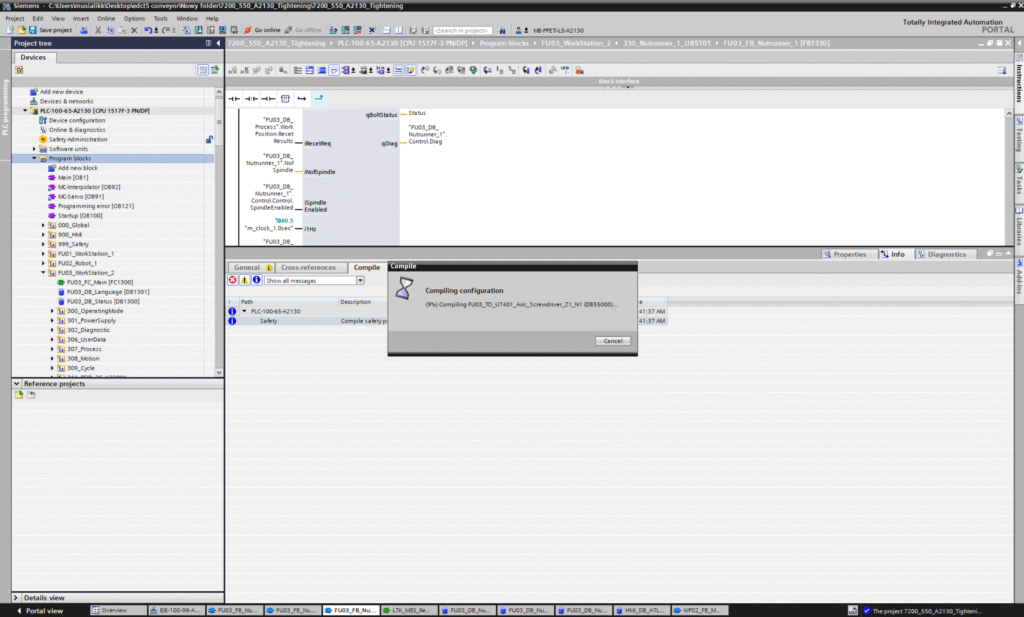
The German manufacturer strongly promotes and develops communication standards based on Profinet networks (formerly the communication standard was Profibus). They provide fast and error-free data exchange and integration of distributed input/output islands. The engineering environment for these systems is the TIA Portal (Totally Integrated Automation). This integrated software allows to program programmable controllers, configure HMI panels and drives in a single project. TIA Portal facilitates rapid error detection thanks to extensive diagnostic functions, allowing continuous reading of precise information about the status of machines.
Rockwell Automation (Allen-Bradley) – American standard of reliability
The Allen-Bradley brand, belonging to the Rockwell Automation group, is a key supplier of control systems for processing, petrochemical, and automotive plants. Its flagship controller families, such as the multitasking, modular ControlLogix systems and the smaller, compact PLCs from the CompactLogix series, are distinguished by exceptional resistance to harsh environmental conditions and operational reliability.
Communication in Rockwell Automation systems is based on the EtherNet/IP protocol, which enables seamless vertical integration with production management systems MES and SCADA systems. Programming of PLC controllers of this brand is carried out in the advanced Studio 5000 environment. These systems are highly valued by integrators for flexible online code editing without the need to stop the technological process, which eliminates production downtime during modernization.
Schneider Electric – pioneer of digitization and open standards
Schneider Electric actively develops automation systems focused on digital data transmission and integration with the Industrial Internet of Things (IIoT) architecture. The French manufacturer provides universal families of Modicon controllers, including the compact M221 models, the versatile M241 and M251, as well as the highly advanced, modular Modicon M580 process controllers with a built-in Ethernet interface directly on the backplane.
Schneider Electric is the creator of the Modbus protocol, which to this day remains the most universal open communication standard in industry, enabling the connection of devices from different manufacturers. This manufacturer’s modern PLCs are programmed in the EcoStruxure Machine Expert environment. This tool supports the international standard IEC 61131-3, allowing engineers to write code using languages such as LD, ladder, ST, structured text or FBD, function block diagram.
Mitsubishi Electric – Japanese precision and reliability
Mitsubishi Electric is building its position in the global market by delivering extremely fast and reliable control systems for machines and equipment. The main pillar of the offering is the MELSEC family of controllers, which includes the compact MELSEC-F controllers, the modular MELSEC-Q series controllers, and the latest, extremely high-performance MELSEC-iQ-R platform.
These devices are widely used in mass-production machines, assembly lines and advanced motion control systems due to their excellent support for high-speed counters and servo-drive positioning. Communication in Mitsubishi systems is often based on the open, gigabit network standard CC-Link IE, although these controllers also support other popular networks such as Profinet, Modbus and EtherCAT. The GX Works software enables intuitive code creation, network configuration and efficient viewing of machine operating parameters.
What should you pay attention to when choosing a supplier of PLC controllers for a factory?
When choosing a PLC controller, one should be guided primarily by operational and business criteria, and not only by the dry technical parameters of the CPU processor. The choice of a specific platform affects the total cost of ownership (TCO) and the flexibility of modernizing the machine park.
The key factors in the choice are:
- Availability of engineering staff in the local market – the ease of recruiting automation engineers and integrators familiar with a given system directly translates into the time and costs of implementing modifications.
- Technical support and manufacturer service – the responsiveness of the manufacturer’s technical hotline and the guaranteed delivery time of replacement modules from local warehouses in the event of a sudden failure are of key importance.
- Scalability and modularity – a modern control system should have extensive possibilities for expansion with additional communication modules, analog and digital input/output modules, and technology modules without the need for costly replacement of the central unit.
- Length of product life cycle – leading PLC manufacturers ensure the availability of spare parts and support for their product families for a minimum of 10–15 years from the moment a given series is withdrawn from sale.
Investment in automation is also a matter of an appropriate budget, which includes both the purchase of physical components and software licenses, as well as the costs of system integration.