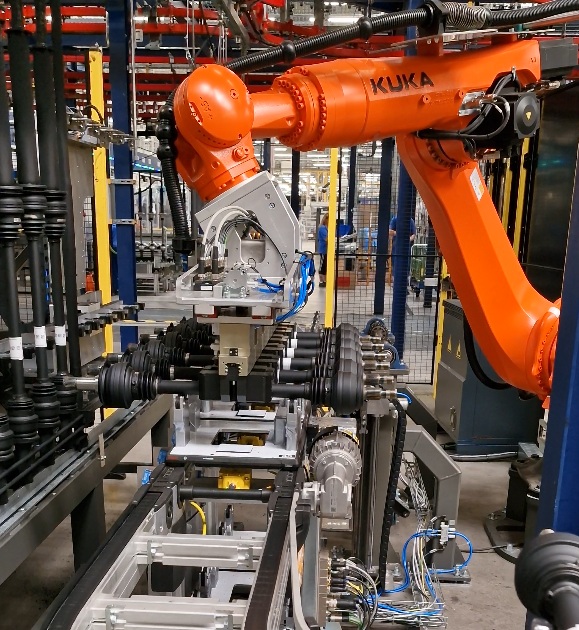
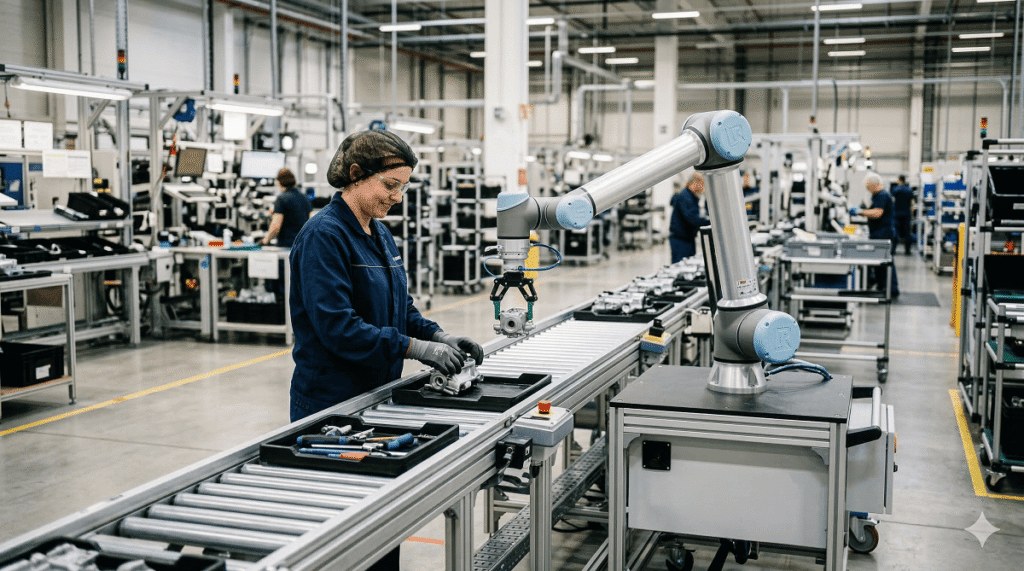
Robotization has been driving modern industry for years and is an indispensable element in today’s production transformation. One of the most groundbreaking achievements of recent years are cobots, or collaborative robots. Unlike traditional industrial robots, which operate behind cages, cobots were created to work safely arm-in-arm with people. This innovative approach opens up entirely new possibilities in automation, making production more flexible and efficient. Automation using robots is truly changing the face of the entire industry.
- List of cobot advantages
- Increased efficiency and productivity thanks to collaborative robots
- Flexibility and ease of cobot integration in the manufacturing process
- Improving quality and precision in production through the use of cobots
- Work safety and improvement of working conditions for employees
- Cobots as human helpers at the workplace
- Specific improvements in the production process
- Challenges related to project implementation and how to deal with them
- FAQ – Frequently asked questions
List of cobot advantages
Increased efficiency and productivity thanks to collaborative robots
Cobots, by performing repetitive and time-consuming tasks with unwavering precision, can significantly accelerate the production process. They enable round-the-clock work, without breaks or a drop in efficiency, which directly translates into a larger production volume. They allow us to robotize the most monotonous activities.
Importantly, employees, freed from these tasks, can focus on more complex operations requiring creativity and decision-making. Thanks to this, the entire production process simply becomes more efficient. This is a really important element of process automation.
Flexibility and ease of cobot integration in the manufacturing process
One of the biggest advantages of cobots is how easy they are to program and integrate into existing production lines. Compared to large industrial robots, cobots are often lighter, smaller, and simply more mobile. They can be quickly re-tooled for different tasks, which is invaluable, especially for short-run production.
This flexibility makes cobots an ideal solution for companies that must dynamically adapt their processes to the constantly changing needs of the market. They allow for a quick response to new orders and the introduction of modifications to products.
Improving quality and precision in production through the use of cobots
An extremely important benefit of using cobots is a significant improvement in the quality of manufactured products. Their repeatability of movements minimizes the risk of human errors that can occur during manual execution of precise tasks. Advanced sensors and cameras cooperate with the robotic arm, thereby guaranteeing high accuracy.
Thanks to the precision and repeatability of cobots, businesses can reduce the number of defective products and the amount of production waste. This translates into lower production costs and, equally importantly, greater customer satisfaction.
Work safety and improvement of working conditions for employees
Cobots were designed with human safety in mind. Equipped with force sensors and movement restrictions, they can safely collaborate with humans without the need for additional safeguards. Working alongside a robot simply becomes safer.
By taking on tasks that are dangerous, repetitive, or physically demanding, cobots protect employees’ health and prevent injuries. This allows operators to focus on more engaging and less risky aspects of their work.
Cobots as human helpers at the workplace
In practice, human-robot collaboration can take various forms. For example, a cobot can feed parts to a worker with high precision, while the human handles complex assembly. It can also operate machines, move heavy objects, and even perform welding tasks.
Thanks to this, employees can perform tasks requiring greater dexterity, perceptiveness, or problem-solving skills, while the robot takes over routine, physically demanding, or precise tasks. This allows for an increase in efficiency and the quality of the final product.
Specific improvements in the production process
By utilizing cobots, the company observed a significant reduction in the time required for assembling individual modules. The repeatability of the robot’s movements eliminated errors that previously led to the need to reject product parts. Additionally, cobots enabled 24/7 operation, which increased the company’s overall production capacity.
Challenges related to project implementation and how to deal with them
The implementation of new technologies, such as collaborative robots, comes with certain challenges. In this case, it was necessary to provide appropriate training for employees so that they could work effectively with the robots and program them for new tasks. The initial investment also required a thorough analysis of the return on investment (ROI).
Cobots are a revolutionary solution for modern production, offering unparalleled advantages in terms of efficiency, flexibility, precision, and work safety.
Key advantages of cobots
| Benefit Area | Description |
|---|---|
| Efficiency and productivity | Cobots perform repetitive tasks faster and without errors, enabling continuous work and increasing production volume. They allow employees to focus on tasks requiring creativity. |
| Flexibility and integration | They are easy to program and quick to adapt to various tasks, which is ideal for short-run production. They can be easily moved and integrated with existing lines. |
| Quality and precision | They minimize human errors through the repeatability of movements and advanced sensors, which leads to a reduction in defective products and waste. |
| Occupational safety | They were designed for safe cooperation with people, equipped with collision-prevention sensors. They take over dangerous and physically demanding tasks. |
| Cost reduction | Increased efficiency, fewer errors, and waste reduction translate into lower operating costs and greater profitability. |
| Employee support | They relieve people from monotonous and heavy tasks, allowing them to focus on more valuable and engaging activities, which increases job satisfaction. |