Automation and robotization are fields that are constantly evolving, introducing new, innovative solutions into our lives. More and more often we hear about traditional industrial robots and their newer cousins – cobots. Although both terms refer to automated machines, they do not mean the same thing at all, and despite seeming similar at first glance, they possess fundamental differences that affect their application and how they interact with humans. The role of automation in industry is growing increasingly, and understanding the technological nuances is absolutely essential to fully utilize the potential of robotics.
- What are robots and cobots? Understanding the difference
- Definition of an industrial robot and a cobot
- What is a cobot (collaborative robot)?
- Key differences between a robot and a cobot
- When to choose a cobot instead of an industrial robot? Usage scenarios
- Typical applications of cobots in industry
- Advantages and disadvantages of cobots
- Cobot cost: An investment that pays off?
- Key differences between a cobot and a robot
- Facts and statistics
- FAQ – Frequently asked questions
What are robots and cobots? Understanding the difference
An industrial robot is a traditional automatic machine, designed for repetitive tasks in an isolated area, with high power and precision, requiring protective barriers. In contrast, cobot (collaborative robot) is a robot that collaborates with humans in the same room, equipped with safety systems such as collision sensors and force/speed limiters, easy to program and flexible in changing tasks. Although both types of machines have their place in modern industry, their operating philosophy and applications differ significantly from each other.
Definition of an industrial robot and a cobot
What is an industrial robot?
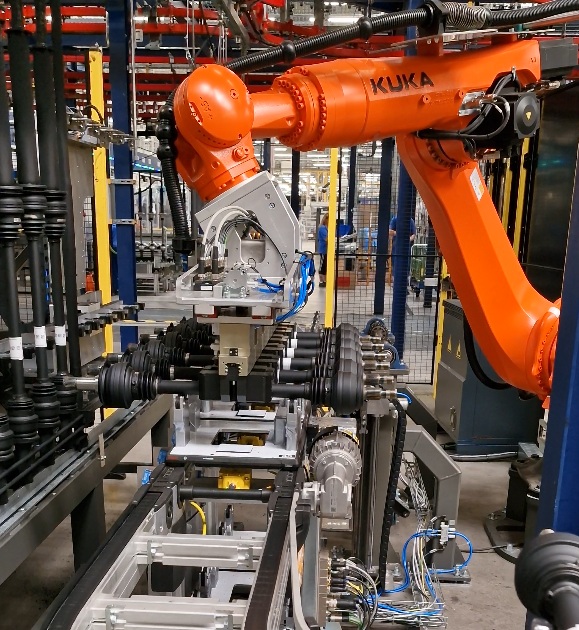
An industrial robot is a machine that usually operates autonomously or is remotely controlled, performing repetitive tasks in a predetermined space. Its traditional design is often characterized by high power and high speed, which allows for the quick and efficient execution of complex operations. In the past, due to its parameters and potential hazards, the industrial robot required the use of enclosures and safety barriers to ensure a safe distance from humans. This has been a fundamental element in many industries for years.
What is a cobot (collaborative robot)?
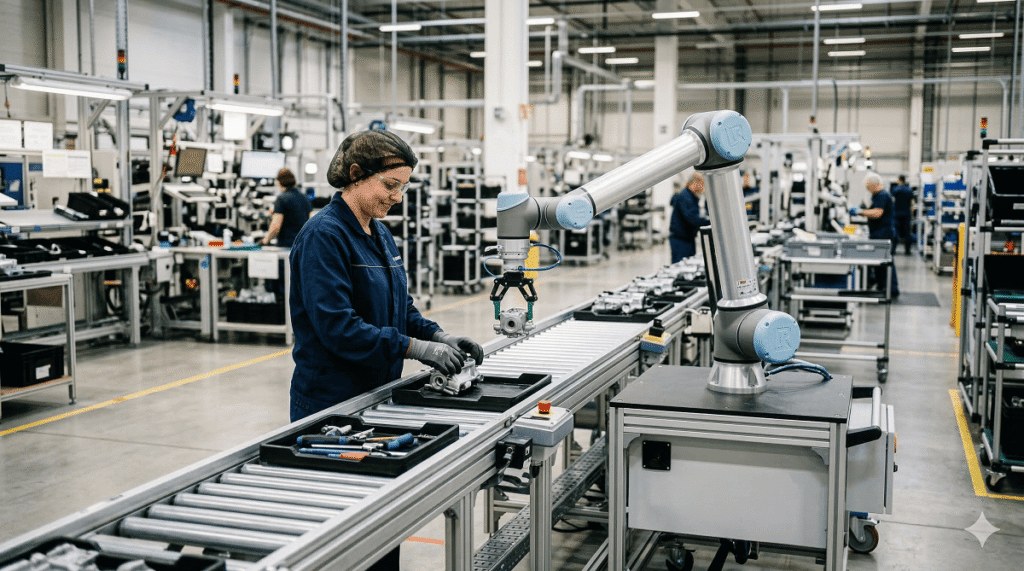
The term “cobot” is an abbreviation for “collaborative robot” (collaborative robot). The main distinguishing feature of a cobot is its ability to collaborate with humans in the same workspace. Cobots are designed to work safely in direct proximity to the operator, minimizing the risk of collisions and hazards. This definition emphasizes its purpose for interaction, rather than isolation from the human workforce.
Key differences between a robot and a cobot
1. Safety and interaction with humans
The most fundamental difference between a traditional industrial robot and a cobot is the way they approach human interaction. Cobots are designed with a priority on safe contact with the operator. They are equipped with advanced sensors, force limiters, and special safety systems that allow for immediate stopping of movement in the event of an obstacle or contact detection. In contrast, an industrial robot, due to its power and speed, requires the use of physical barriers, such as cages or fences, to isolate its operating zone and prevent potential collision with a worker.
2. Programming and flexibility
The process of robot programming constitutes another significant difference. Cobots are often characterized by much greater ease of programming. Many of them can be programmed intuitively, for example, through so-called “lead-through programming,” where the operator manually moves the robot arm to desired positions. They also offer user-friendly interfaces, making them accessible to a wider range of users, including the small and medium-sized enterprise sector. Traditional industrial robots typically require specialized programming knowledge and are less flexible in reconfiguration, which can hinder rapid changes in the production line.
3. Speed and Force
Cobots, to ensure safe cooperation with humans, usually operate at a lower speed and with less power than their industrial counterparts. This is a conscious compromise that enables smooth and safe work side-by-side. In contrast, an industrial robot is designed to achieve much higher speeds and possess greater force, which is essential for tasks requiring rapid movement of heavy components or intensive processing. These parameters translate into efficiency, but at the cost of requiring separation from humans in production processes.
When to choose a cobot instead of an industrial robot? Usage scenarios
The choice between a cobot and a traditional industrial robot largely depends on the specifics of the task and the work environment. Cobots are excellent in situations where close human-machine collaboration is crucial. They are an ideal solution for the small and medium-sized enterprise sector, where a lower implementation cost and less demand for production space are often important. Their flexibility allows for quick reconfiguration of the production line when changing assortment or introducing new products. Cobots are also the preferred choice when execution precision, rather than extreme speed, is the priority. They are perfectly suited for tasks requiring delicacy and accuracy, where human dexterity can be supported by the robot’s repeatability and stability.
Typical applications of cobots in industry
Cobots are used in many diverse industrial sectors. They are utilized for the precise assembly of small components, where they can collaborate with employees by handing them parts or performing repetitive tasks. They also excel in quality control, where, thanks to vision systems, they can perform automatic product inspections. Cobots facilitate work in palletizing and de-palletizing, reducing the physical strain on employees. They can operate CNC machines, loading and unloading parts, thus optimizing the production cycle. Even in demanding tasks such as welding, cobots, due to their precision and repeatability of movements, are becoming an increasingly popular solution, supporting the operator and improving quality standards.
Advantages and disadvantages of cobots
Advantages of cobots
The main advantages of cobots revolve around their flexibility and safety. This combination makes them an attractive choice for many companies. Cobots are much easier to program than traditional industrial robots, which speeds up their implementation process and shortens the time needed for staff training. Lower Total Cost of Ownership (TCO), the ability to integrate with existing production processes, and a smaller space requirement are additional significant advantages that contribute to their growing popularity in automation.
Disadvantages of cobots
Despite numerous advantages, cobots also have certain limitations. Their main disadvantage is usually lower speed and power compared to classic industrial robots. This makes them potentially unsuitable for applications requiring extreme speed or handling very heavy loads, where lifting capacity is crucial. In some cases, even when collaborating with a human, they may require additional tools and safety systems, especially when working with sharp tools or when there is a risk of contact with sharp-edged elements. Working with them requires careful consideration of potential risks.
Cobot cost: An investment that pays off?
The purchase price of a cobot itself is often lower than the price of a traditional industrial robot. However, it is important to remember the additional costs associated with its implementation, which include installation, software configuration, the purchase of appropriate end-effectors, and integration with existing production processes. Return on Investment (ROI) depends on many factors, including the type of application, the potential to shorten production time, the reduction in the number of errors, and relieving employees from monotonous or dangerous tasks. Automation using a cobot can be more accessible and cost-effective for many companies, including smaller businesses, than implementing a powerful, traditional robotic system.
Key differences between a cobot and a robot
| Aspect | Industrial robot | Cobot |
|---|---|---|
| Safety | Requires fencing, light curtains; high speed and force | Built-in collision sensors, E-stop, force/speed limiters; stops on contact with a human |
| Flexibility | Dedicated to a single task, long programming and implementation | Easy reprogramming (e.g., hand-guiding), quick task change; ideal for small-batch production |
| Size and mass | Heavy (often >1 ton), requires anchoring | Lightweight (up to 64 kg), smaller lifting capacity (3-20 kg) |
| Work environment | Isolated zone | Barrier-free, shoulder to shoulder with a human |
Facts and statistics
- Payload and speed: cobots have a lower payload capacity (e.g., up to 35 kg in palletizing) and limited speed in collaborative mode, but they make up for it with flexibility – e.g., one day they operate a CNC machine, the next day a press brake.
- Cost and implementation: lower initial price and simpler implementation of cobots (without anchoring) make them popular in small batches; the weight of a cobot arm is max. 64 kg vs. tons for industrial robots.
- Applications of cobots: welding, grinding, polishing, Pick&Place, riveting, gluing; thanks to force sensors, they replace tedious human tasks.
- Origin: cobots emerged from the need for automation of short/medium production runs, where flexibility outweighs extreme efficiency.
Cobots are effective in dynamic production, industrial robots – in high-volume, high-efficiency production. The choice depends on integration with the process and safety standards.