Robotic rotor production line – DANA Incorporated
Comprehensive implementation of a robotized production line for electric motor rotors for a global leader in the automotive industry.
Client
DANA Incorporated – Åmål, Sweden
Scope of cooperation
PLC programming, robot programming, commissioning, process optimization
Implementation period
2023-2025
Languages of the project
English
About the project
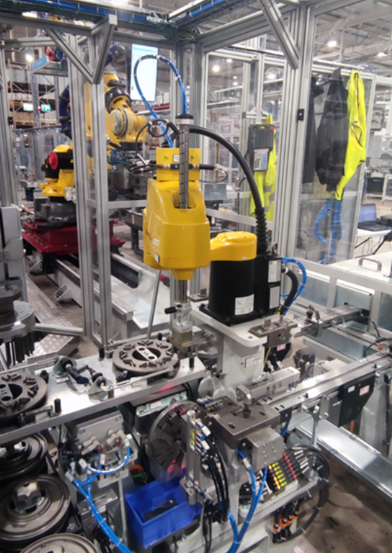
In the years 2023-2025, for DANA Incorporated in Sweden, we carried out an advanced project to build a robotic production line dedicated to manufacturing rotors for electric motors. The aim of the project was to create a fully automated and precise production system that would meet the highest quality and performance standards. A key element of the line was the FANUC R-2000iC/270F robot, moving along a linear rail, responsible for transporting components between stations, and a FANUC Scara robot for the precise assembly of magnets. Our team, consisting of experienced specialists in the field of PLC programming and programming of robots, ensured the comprehensive implementation and commissioning of the system.
Scope of work
As part of the project we were responsible for a wide range of work, including comprehensive programming of PLC controllers and industrial robots. Our role focused on integrating all components of the line, ensuring smooth material flow and coordinating processes at the individual stations. The scope of work also included a detailed I/O check, the development and optimization of control algorithms, as well as precise tuning of the equipment operating parameters to achieve the set performance and quality targets.
Key elements of the scope
1) Preparation of cores and preliminary assembly
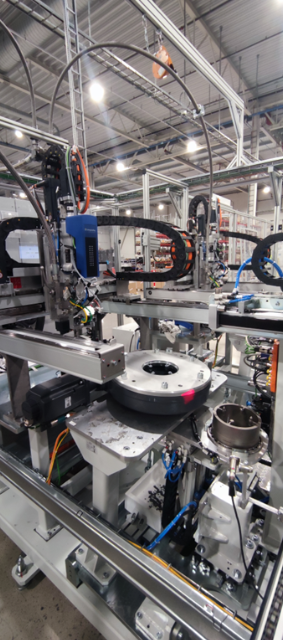
Core preparation area (“cores”), where they are loaded onto the conveyor. Next, the following processes take place: application of adhesive to the inside of the cores using an Atlas Copco two-axis dispensing system (the project required specialist knowledge in the field of automation of gluing processesinserting magnets into glue-filled holes using a FANUC Scara robot and loading/unloading at the station.
2) Creating the “stack” and twisting
The prepared cores are precisely arranged one on top of the other, forming the so-called “stack”, and then screwed together at a manual station using an Atlas Copco PF4000 screwdriver.
3) Burn-in of components
Completed “stacks” are subjected to a heat-treatment process at specially arranged workstations using Eldec equipment that provides precise control over the temperature cycle.
4) Press-fitting the roller and cooling
After heat treatment, the roller is press-fitted using a Kistler press. Then the entire component is transferred to a cooling station, which is crucial for stabilizing the material.
5) Dismantling of auxiliary components
In the second part of the process, the screws that were tasked with holding the “stack” during the heating and pressing stages are unscrewed.
Project challenges
The project was characterized by a high degree of complexity, resulting from strict quality constraints and the integration of many specialized processes. A particular challenge was ensuring appropriate sequences of temperature levels and times during heat treatment, precise hot pressing of components, as well as accurate balancing and magnetization of the final product. A critical aspect was also the application of adhesive to the interior of the cores, which required hundreds of hours of testing, optimal selection of parameters such as pressure, flow, adhesive grammage over time, and precise development of the applicator’s travel paths.
Main challenges
Technologies and solutions used in the project
| Industrial robots | FANUC R-2000iC/270F |
| SCARA robots | FANUC Scara |
| Dosing systems | Atlas Copco two-axis dosing system |
| Assembly tools | Atlas Copco PF4000 screwdriver |
| Heating systems | Eldec |
| Press | Kistler |
| Balancing systems | Schenk |
| PLC control | Siemens TIA Portal |
Effects and benefits for the client
The most important results
• Significant optimization of the production line’s takt time.
• Increase in efficiency and throughput of rotor production.
• Ensuring repeatability and high precision in critical processes, such as gluing and assembly.
• Guarantee of compliance with strict quality standards of the final product.
• Minimizing the risk of human errors through automation.
• Commissioning of a fully automated production process meeting the customer’s requirements.
Added value for the DANA Incorporated factory – Åmål, Sweden
Thanks to the implementation of a robotic line, DANA Incorporated has gained a significant competitive advantage in the production of electric motor rotors. The optimized takt time of the line and increased efficiency translate into lower unit production costs and greater scalability of processes. High repeatability and precision ensure consistent, top-quality products, reducing the number of complaints and streamlining the supply chain. It is an investment in the future that guarantees long-term growth in productivity and profitability.
Why do clients choose us for projects?
Our experience in carrying out complex projects for global players such as DANA Incorporated positions us as a partner capable of meeting the most demanding challenges. We specialize in programming FANUC robots and PLCs (Siemens TIA Portal), integrating diverse technologies from multiple suppliers. The ability to optimize bonding, heating, and precise assembly processes, confirmed by hundreds of hours of testing, constitutes our unique value. We guarantee timely and efficient execution, even in the face of complex quality constraints.
Summary
The robotic production line project for rotors at DANA Incorporated in Sweden is an example of a successful implementation in which complex technological processes and strict quality requirements were fully automated. Our team, drawing on interdisciplinary knowledge and experience, delivered a solution that significantly increased production efficiency and precision while ensuring compliance with global automotive industry standards.
Contact us – we will respond within 24 hours!
Do you have questions about production automation? Fill out the contact form, and our team will contact you within 24 hours — by phone or email.
During a conversation or correspondence, we will jointly define the scope of the work and services you are interested in. Then we will carry out an internal analysis of your inquiry in order to prepare the best possible solution.
We will get back to you within a maximum of 5 working days with information about the next steps.
Take a step towards modern automation – fill out the form now!