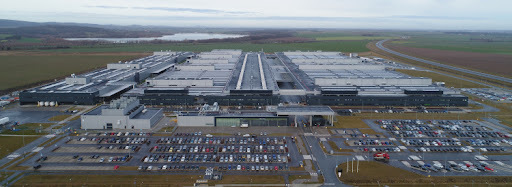
Mercedes-Benz Jawor: engine assembly line
The project involved the comprehensive commissioning and integration of assembly lines for both Diesel and gasoline engine production at the newly established Mercedes-Benz manufacturing facility in Poland.
Client
Mercedes-Benz Manufacturing Poland – Jawor Plant
Scope of work
PLC Programming • Robotics • Integration of Nutrunning & Dispensing Systems • Leak Testing • Machine Vision Inspection
Project duration
2018 – 2020
Project languages
Polish, German, English
About the project
The project inBetween 2018 and 2020, we successfully commissioned two strategic assembly lines for the Mercedes-Benz plant in Jawor. The project focused on high-performance powertrain units (Diesel and gasoline) and spanned three core stages of the production process: Rumpf (Engine Block Assembly), Kalttest (Cold Testing), and Endmontage (Final Assembly).
The lines featured a sophisticated mix of manual stations, semi-automated units, and fully automated robotic cells, ensuring the peak precision and throughput required by Mercedes-Benz’s rigorous manufacturing standards.
Scope of work
A dedicated team of 6 specialists (4 PLC Programmers and 2 Robotics Engineers) was responsible for:
– PLC Programming: Development and implementation of Siemens PLC software in accordance with Mercedes-Benz global standards.
– Robotics: Integration and programming of KUKA industrial robots.
– Systems Integration: Seamless integration of specialized process technologies, including nutrunning (fastening), dispensing, and machine vision systems.
– Material Flow Coordination: Managing the interface and material flow between different factory levels, including synchronization with overhead conveyor systems (EMS/power-and-free).
– Commissioning & Optimization: Conducting rigorous testing, cycle time optimization, and providing comprehensive technical support during the production ramp-up phase.
Key scope elements
1) PLC Programming
– Control Logic Implementation: Full development for Rumpf (Block Assembly), Kalttest (Cold Test), and Endmontage (Final Assembly) lines.
– Process Parameterization: Handling and fine-tuning of advanced assembly sequences.
– Data Integration: Seamless communication with higher-level plant systems and comprehensive Product Traceability implementation.
2) Robotics
– KUKA Programming: Advanced programming for both material handling and complex process applications.
– Peripheral Synchronization: Ensuring flawless interaction between robots and external auxiliary equipment.
3) Motion Control
– Drive Systems: Configuration and performance optimization of SINAMICS S120 high-performance drives.
4) Process Technology Integration
– Nutrunning Systems: Full integration of Cleco DGD and mPro tightening solutions.
– Dispensing Systems: Implementation and management of SCA Atlas Copco sealing and bonding systems.
– Testing & Marking: Integration of JW Froehlich leak testing stations and component marking/engraving systems.
5) Vision Systems & Identification
– Quality Control: Deployment of machine vision inspections based on the NeuroCheck platform.
– Automated Identification: Integration of COGNEX scanners for high-speed code reading and component verification.
Project challenges
One of the most complex and critical phases was the automated transfer station, responsible for moving the machined engine blocks from the Rumpf line to the overhead conveyor system located on the upper floor. This task required precise synchronization and close technical collaboration with Siemens specialists, who managed the elevator and overhead transport systems.
Main challenges
Technologies and solutions used in the project
| PLC Controllers | Siemens SIMATIC S7-1500 / TIA Portal |
| Robotics | KUKA |
| Drives & Motion Control | SINAMICS S120 |
| Machine Vision & ID | NeuroCheck, COGNEX |
| Assembly & Fastening Systems | Cleco DGD, mPro |
| Dispensing Systems | SCA Atlas Copco |
| Leak Testing | JW Froehlich |
Project outcomes and client benefits
Key results
On-time Commissioning: Successful and timely startup of strategic assembly lines at the new production facility.
Full-Scale Automation: End-to-end automation of critical processes, including dispensing, fastening, and vertical transport.
100% Traceability: Implementation of a robust system ensuring full data tracking for every engine assembled.
Enhanced System Reliability: Maximum uptime of automated stations achieved through advanced robot and drive-system optimization.
Added value for the Mercedes-Benz Jawor:
Process Security: Integration of precision dispensing and fastening systems eliminated the risk of assembly errors in the engine’s critical structural joints.
Intralogistics Efficiency: The seamless interface between the Rumpf line and the overhead conveyor system (developed in collaboration with Siemens) optimized floor space utilization and material flow.
Premium Quality Assurance: Deployment of advanced machine vision and leak-testing systems guarantees that every powertrain unit meets Mercedes-Benz’s stringent global quality standards.
Why Clients choose us for commissioning projects?
– Expert OEM Standard Knowledge: Deep expertise in the specific programming requirements and technical standards of the Mercedes-Benz Group.
– Interdisciplinary Expertise: We seamlessly combine PLC programming with advanced robotics (KUKA) and specialized process technologies (SCA, Cleco, JW Froehlich).
– Partnership & Collaboration: Proven ability to effectively coordinate with multiple technology providers simultaneously (e.g., synchronization with Siemens systems).
– Greenfield Project Experience: Demonstrated success in commissioning lines within newly established facilities, where flexibility and adaptability to dynamic design changes are critical.
– Implementation Stability: We provide comprehensive support throughout the entire lifecycle—from initial startup to the SOP (Start of Production) stabilization phase.
Project Summary
The project completed for Mercedes-Benz Manufacturing Poland in Jawor is a prime example of excellence in managing complex commissioning processes within the automotive industry. By integrating advanced fastening, dispensing, and leak-testing systems with a unique multi-level transport solution, our team delivered production lines characterized by the highest levels of automation and reliability. This execution reaffirms our capability to manage large-scale investments for leaders in the premium automotive segment.
Contact us – we’ll respond within 24 hours!
Do you have questions about production automation? Fill out the contact form, and our team will get back to you within 24 hours – either by phone or email.
During the conversation or correspondence, we will define the scope of work and services you are interested in. Then, we will conduct an internal analysis of your inquiry to prepare the best possible solution.
Within a maximum of 5 business days, we will get back to you with information on the next steps.
Take the step towards modern automation – fill out the form now!